The Theodore Roosevelt Presidential Library Honors a Conservationist
✕
America’s vast landscapes captivated Theodore Roosevelt long before he became president, but none more so than the towering buttes, scoria hills, and prairies of the Dakota Territory. Beginning in 1883, the young New Yorker spent many lengthy stints here—at first in search of bison and then, stricken by grief, perhaps in search of himself. After the deaths, mere hours apart, of his wife Alice (following childbirth) and his mother (to typhoid fever), the 25-year-old state assemblyman retreated from public life to this otherworldly place. He built Elkhorn Ranch, raised cattle, and over several years witnessed the effects of our westward expansion: telegraph lines and barbed-wire fences began to litter the country, natural resources were being extracted at unsustainable rates, and those majestic beasts that he initially came to hunt were nearing extinction.
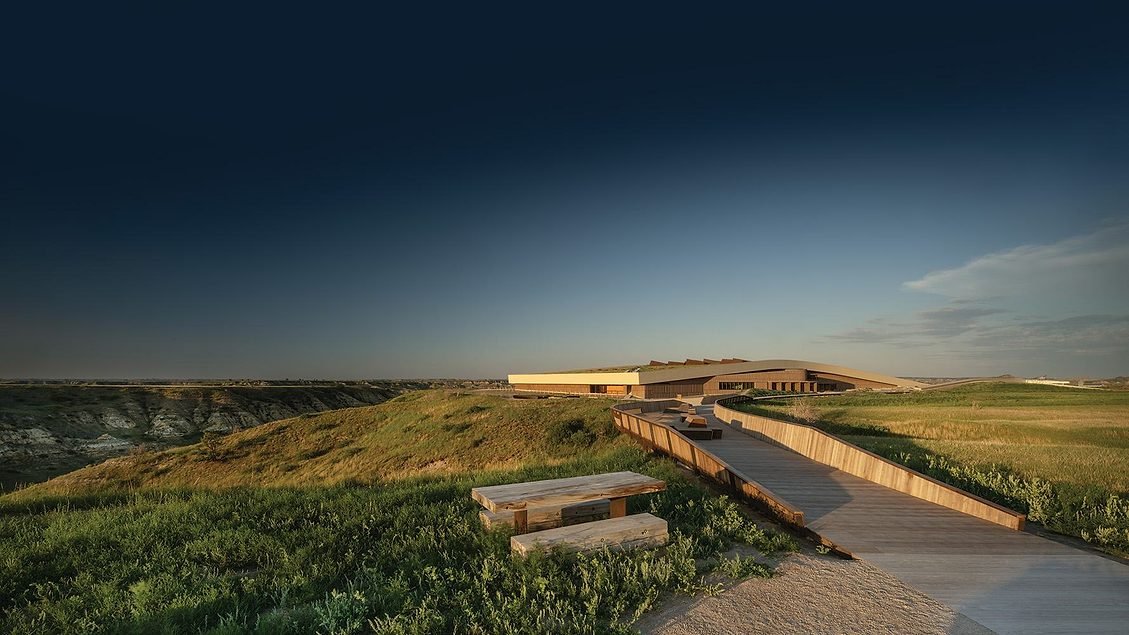
This home away from home profoundly shaped Roosevelt’s views on conservation and, later, his approach to it from the bully pulpit of the presidency between 1901 and 1909. Without question, these so-called badlands were the most appropriate place for the Snøhetta-designed Theodore Roosevelt Presidential Library (TRPL), which opened last month to celebrate his legacy as an outdoorsman, naturalist, and steward of public land.

As the 26th and still youngest-ever commander in chief, Roosevelt formed the United States Forest Service (USFS) and used the levers of government to create or enlarge 150 national forests, 51 federal bird reserves, five national parks, and four federal game preserves. After the passage of the Antiquities Act, he decreed 18 national monuments, including the Grand Canyon, saving the geological marvel from powerful mining interests. By some estimates, he protected 230 million acres—more than all his predecessors combined had—and paved the way for the creation of the National Park Service. Conservation, after all, in the words of his close confidant Gifford Pinchot, meant “the greatest good to the greatest number for the longest time.” In his memory, Congress established what became the Theodore Roosevelt National Park outside Medora, North Dakota, which the library now overlooks.
But the TRPL’s mission aims further: to instill values of leadership and citizenship in future generations, says Edward F. O’Keefe, chief executive officer of the nonprofit that spearheaded the $450 million project. “With all due respect to the other presidential libraries, their intent is to write the first draft of history, to present the president from his perspective,” he says. “We’ve created a space where families can get off their devices and be together in nature—to find the same power in this place that T.R. found.” (Roosevelt preferred this nickname over the popular “Teddy.”)

1

2
The landscape-integrated building gently rises out of the ground (1). Vertically oriented timber clads curving walls (2). Photos © Nic Lehoux
Fittingly, the New York– and Oslo-based firm, in collaboration with JLG Architects as architect of record, devised the TRPL to integrate with its surroundings. “Rather than place a building in the landscape, we sought to make the landscape itself the primary act of architecture,” says Craig Dykers, a founding partner of Snøhetta. A sliver of prairie gently buckles upward to shape a low-slung green roof that spans two volumes and shelters a breezeway between them. From afar, this 96,000-square-foot man-made swell nearly disappears amid nature’s vastness, its subtlety a strategy that bested louder schemes by competition short-listers Studio Gang (with Olin) and Henning Larsen (with Nelson Byrd Woltz) in 2020. Even though the TRPL’s built form speaks softly, it carries the proverbial big stick: an ambitious approach to sustainability. Driven by the client’s brief, the design team established a “Four Zeroes” guiding framework—to realize a library that would produce its own energy, recycle all water by using a closed-loop system, produce zero emissions, and generate zero waste.
Moreover, the library is pursuing the Living Building Challenge (LBC), an environmental standard widely regarded as the world’s most rigorous. In fact, since the LBC’s launch in 2006, only 35 projects have achieved full “Living” certification. Assuming TRPL reaches this benchmark—determined only after the collection and analysis of a year’s worth of data—it will become the largest cultural institution to do so. “Unlike LEED, where you can pick and choose which credits to pursue, an LBC project is all or nothing,” says Nico Kienzl, director at Atelier Ten, which served as the sustainability consultant. “Developing the library’s zero-carbon strategy required the most in-depth life cycle modeling we’ve ever undertaken.”
Among many requirements, LBC projects must generate 105 percent of their operational energy from renewable sources. The all-electric TRPL accomplishes this by first reducing the overall need with a highly efficient envelope and passive-design strategies, which are then buttressed by building systems, including a heat pump, 216 geothermal wells, and a 1.37-megawatt-capacity photovoltaic system. Twenty-five percent of the electric load is produced on-site, while the remainder is sourced a few miles away on library-owned land. The team predicts that, when combined with land-management practices, the building will fully offset its carbon footprint by 2030.

3

4
From the sheltered breezeway (3), visitors can enter the education center lobby (4), which also doubles as an anteroom for the auditorium (5). The museum lobby (6) features rammed-earth walls, skylights, and an exposed mass-timber frame. Photos © Nic Lehoux

5

6
Given the proximity to Interstate 94, which cuts east–west across North Dakota, most visitors will arrive by car. The TRPL shares its site atop a butte with an existing open-air seasonal venue, the Medora Musical, allowing the two institutions to share a parking lot too. But the idyllic 93-acre plat of formerly USFS land connects to an extensive network of trails. Guests can thus easily arrive by bike, on foot, or horse (yes, hitches are available).
Looking for quick answers on architecture and design topics?
Try Ask RECORD, our new smart AI search tool.
Ask RECORD →
Snøhetta, which also acted as the landscape architect alongside Midwest firm Confluence, carefully choreographed a slow and deliberate arrival sequence. At first, a limestone- and timber-clad berm with a shading canopy obscures much of the grounds, focusing visitors’ attention on the library and its own path-laden roof. As they walk forward, the canopy dips into the ground to reveal behind it an expansive prairie and an almost mile-long loop of public boardwalk punctuated by seating areas and follies. Nearer to the library’s main entrance, curving timber-wrapped walls redirect their attention again, to the northeast, where the covered breezeway frames a view of the national park.
The library’s smaller volume—the education center—accommodates an intimate lobby (with a fireplace!), a dividable classroom, staff offices (about 85 people, more than half the population of Medora, will work on-site), and a 300-seat auditorium that’s worth sitting in for the view alone (behind the stage, floor-to-ceiling glazing captures a badlands vista). O’Keefe, as a former media executive, has produced over 50 presidential debates and town halls and hopes to one day host such an event here. How fitting that would be, given Roosevelt’s historic ability to marshal people of opposing perspectives.
Across the sheltered patio, the broad, 28-foot-high museum lobby is an architectural tour de force. Rammed-earth walls, curved in plan and rendered in locally sourced soil, echo the strata of nearby landforms with bands ranging from deep ochre to violet and beige. This hefty yet striking backdrop helps to regulate temperature with its thermal mass too. The floors underfoot are polished low-carbon concrete—slag and fly ash have been partially substituted for carbon-intensive portland cement—with radiant heating and cooling, while a triangulated mass-timber frame overhead alternates between flat panels of slatted Douglas fir and pyramidal skylit coffers lined with blond ash. Ticketing desks were fashioned from slabs of a recently deceased copper beech that Roosevelt planted at Sagamore Hill, his Long Island estate.
A particularly challenging aspect of designing any LBC project, especially one in such a remote locale, is vetting building products for conformity with the certification system’s extensive materials-selection criteria. These include limits on the distances that components can be shipped—a restriction intended to reduce materials’ embodied energy and spur green regional economies. Accordingly, the mass timber was sourced from the Pacific Northwest, and all wood is reclaimed or Forest Stewardship Council certified. The LBC standard also mandates that projects avoid the use of 19 classes of chemicals on its Red List—many of which are commonplace in products, including vinyl, antimicrobials, and volatile organic compounds. The idea is to ensure a healthy environment for occupants, reduce pollution and resource depletion, and incentivize market transformation. “When you aren’t able to source a product within one accepted range, that means needing to make a sacrifice elsewhere,” says Aaron Dorf, a project architect from Snøhetta. “Because LBC is so comprehensive, everything becomes a careful balancing act.”

7

8
Individual exhibits, such as the AI avatar of Roosevelt (8), wrap around a central narrative gallery (7). Photography: © Nic Lehoux (7); © Bryan Bedder/Getty Images for Theodore Roosevelt Presidential Library (8)

9
The walkable roof (9) connects to a boardwalk with follies and seating areas (10). Photos © Nic Lehoux

10
T.R. predated the presidential library system that his distant cousin Franklin Delano Roosevelt would formally start in 1939, so his records are scattered across dozens of institutions. Although many original objects are displayed—including, on loan from the Library of Congress, the diary recording his state of mind while in the Dakota Territory—the TRPL’s exhibitions also rely in large part on electronic and physical facsimiles, audiovisual storytelling, and scenography. While the strategic placement of photosensitive materials in certain galleries helped designers achieve LBC’s requirement that 75 percent of regularly occupied spaces be daylit, the otherwise multimedia-heavy program, totaling some 35,000 square feet, consumes about 40 percent of the building’s electricity. New York–based Local Projects, which oversaw the exhibition design, undertook extensive energy modeling to identify the equipment and technology most suitable for LBC constraints.
Telling the story of a man who largely defied categorization—both a straight-talker and a sensationalist, an intellectual and a cowboy—is an altogether different question. The avid birder kept detailed lists of every avian species he saw from the confines of the White House, yet he had no issue hunting them for taxidermy while roughing it in the wilderness. The exhibitions weave through his life and work, from childhood to his presidency and beyond, including a dive into the progressivism that got him pushed out of the Republican Party, a failed bid for president in 1912 as part of the Bull Moose Party, an unsuccessful assassination attempt, and another near-death experience during a harrowing four-month expedition to the Amazon. A skylit and chronologically organized “narrative gallery” centers the museum experience, while interactive “adventure galleries,” periodically broken by vignettes of the outdoors, snake around the perimeter.
Despite his track record with the environment, labor rights, and suffrage, not all Roosevelt’s views hold up to present-day scrutiny. These issues, particularly those about race or how the creation of federal preserves and parks can be at odds with tribal sovereignty, have been confronted head-on. “Humanize, not lionize,” was the guiding mantra, says O’Keefe, and contemporary voices add welcome context and nuance to those exhibits. Throughout the life of the project, library leaders have been in conversation with the Mandan, Hidatsa, and Arikara peoples, the Standing Rock Sioux Tribe, and the Spirit Lake Nation about content and programming.

The covered breezeway frames a view to the northeast of Theodore Roosevelt National Park. Photo © Nic Lehoux
But perhaps visitors will be most surprised to meet Roosevelt himself—or, at least, a hologram of the man. The AI-driven apparition, trained on more than 15,000 of Roosevelt’s own documents, immediately recalls the joke-slinging animatronic Lyndon B. Johnson at that presidential center. Clearly, the TRPL has taken a leap of faith with a technology that stirs the same mixed feelings of fear, unease, and hope that the Western frontier perhaps once did. In one noteworthy interaction during the opening, President Trump asked “him” if the Panama Canal was his most important achievement. The software, emulating Roosevelt’s reputed media savvy, ultimately brought the focus back home: “I measure my greatest work by the lives improved, parks set aside, food and drugs made safe, the Square Deal given to all, not just a few.”
Considering their integration, outdoor strategies are as thoughtful as the architectural ones. “Stewardship is not a fixed goal but an ongoing practice,” says Michelle Delk, Snøhetta partner and director of the studio’s landscape discipline. The Native Plant Project, a partnership among the library, Resource Environmental Solutions, and North Dakota State University, saw the collection and cultivation of seeds from some 193 native species used to populate the grounds and the green roof (which uses salvaged soil). Time-tested land-management techniques—such as grazing and controlled burns—will maintain and improve biodiversity.
“Roosevelt understood that conservation is not simply about protecting land; it is about defining our relationship to the world and our responsibility to future generations,” says Dykers. In the national park across the valley, pronghorns, wild horses, and bison still graze freely for all to appreciate—partly due to the groundwork that Roosevelt laid over a century ago. In fact, 700,000 visitors continue to make the trek there each year. Now, those same visitors will have a new landmark to see: a presidential library that blazes a trail of its own—one we should hope others will follow.


Images courtesy Snøhetta; click to enlarge.
Credits
Architect:
Snøhetta — Craig Dykers, Michelle Delk, Matthew McMahon, Aaron Dorf, Kurt Marsh, Daniel Marty, Prince Langley
Architect of Record:
JLG
Landscape Architects:
Snøhetta, Confluence
Engineers:
Morrissey Engineering (MEP/FP/IT); Sherwood, AE2s (civil); Magnusson Klemencic, Steyer Engineering (structural); KLJ (traffic)
Consultants:
RES (ecology); Arup (lighting, acoustics, AV); Atelier Ten (sustainability); Front (envelope); Ricca Design Studios (food service); Local Projects, Future of Storytelling, Dimensional Innovations (exhibitions)
General Contractor:
JE Dunn
Client:
Theodore Roosevelt Presidential Library Foundation
Size:
96,000 square feet
Cost:
$450 million (total)
Completion:
July 2026
Sources
Mass Timber:
Mercer Mass Timber
Structure:
True North (steel); Winn Construction, Dickinson Ready-Mix (concrete); Earth Wall Builders, Winn Construction (rammed earth)
Cladding:
Eden Valders (masonry); Standard Sheet Metal (weathering steel); Agnora (curtain wall); Thermory, ReSawn Timber, Bell Lumber & Pole (wood)
Windows/Doors:
CRL (doors); Solatube (skylights); H Window
Landscape:
Arbor Wood, Midwest Black Locust, InCord
Interior Finishes:
Corkeen (cork flooring); TOTO, Kohler (fixtures); Linea (acoustical panels); Keim Innostar, Benjamin Moore (paints/stains); Krion, Cambria Quartz (solid surfacing); Fireclay, Mosa (tile); Duracryl (resilient flooring)
Lighting:
Bega, Lucifer, Structura