Three Pacific Palisades Schools Rebuild for the Future
✕
In the aftermath of a May 22, 2011, tornado that leveled large swaths of Joplin, Missouri, DLR Group played a key role in rebuilding as the designer, with CGA Architects, of interim and permanent public high schools to replace the one lost on that date—in a cruel twist, the same day as graduation. “The school became the center of the community and helped, in the rebuilding process, as a social anchor,” says Alenoush Aghajanians, principal and senior design leader at DLR Group, emphasizing the school’s role as an essential civic presence as the city gradually emerged from the rubble.
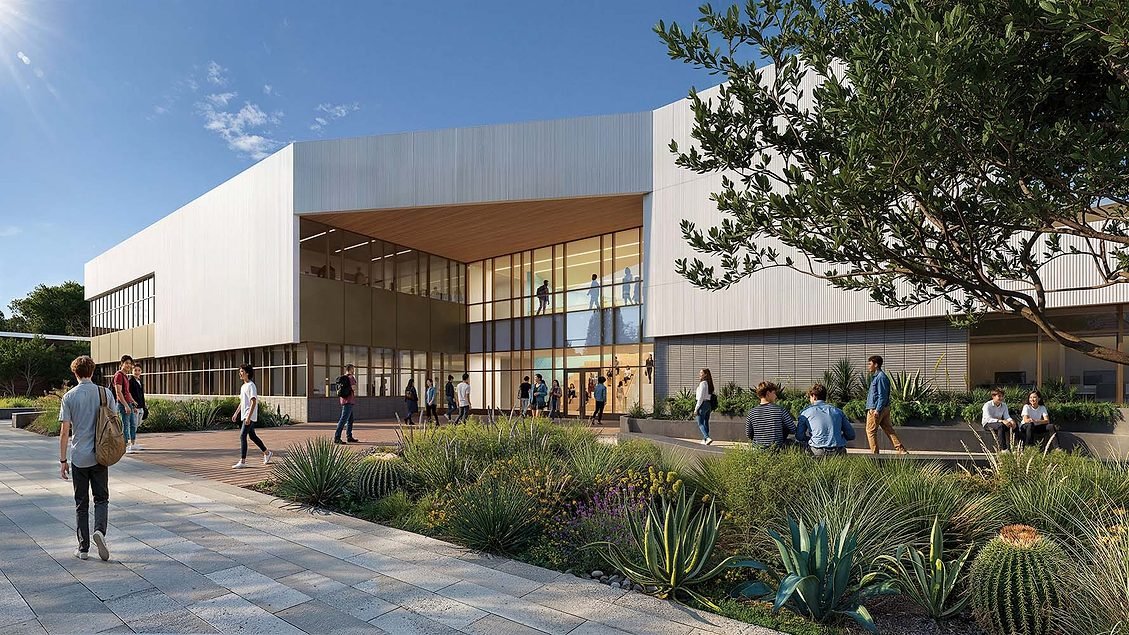
The urgency and breakneck mobilization involved in building Joplin’s new high school, along with the opportunity to reimagine educational strategies and build back better, provided DLR Group with a sturdy foundation to embark on a project currently under way in Los Angeles: a new two-story classroom building on the campus of Palisades Charter High School. Colloquially known as Pali High, the school suffered damage during the Palisades Fire in January 2025, which decimated coastal L.A.’s Pacific Palisades neighborhood and surrounding communities as it raged for nearly a month. The school, however, was somewhat lucky, as much of its campus—established in 1961 in a filled-in canyon below Sunset Boulevard and famed as a filming location for many movie and television productions—was largely spared from the widespread destruction. An aging 1950s shop building, which the fire-resilient new academic hub replaces, and several portable classroom buildings were the only structures completely lost to the inferno, with roughly 70 percent of the classroom inventory surviving.
The reimagined Pali High campus is one of three school rebuilding projects in progress in the fire-ravaged Palisades as part of a $604 million initiative led by the Los Angeles Unified School District (LAUSD). Just to the east of Pali High, near the commercial core of the neighborhood, is Palisades Elementary Charter School. Heavily damaged by the wildfires and losing multiple buildings, that compact campus, which features a surviving historic main administration/classroom building, is being redeveloped with local firm Practice (formerly GGA+) serving as project architect. To the west, Marquez Charter Elementary, which suffered a total loss (save for three portables), is being rebuilt as a 53,000-square-foot building with a design by NAC Architecture.

The reimagined campus of Marquez Charter Elementary School. Image courtesy NAC, click to enlarge.
Each of the three LAUSD projects is slated to be completed by the end of 2028. With varying budget sizes, they employ fire-adaptive materials and resilient landscaping, along with rigorous sustainability measures, as mandated by the district.
Meanwhile, the Marquez and Pali High campuses have or are on track to reopen—in September and later this January, respectively—following extensive clean-up efforts and environmental testing. While rebuilding is in progress, modular classroom units have been installed, and, at Pali High, surviving, smoke-remediated buildings are being repopulated to get students back on campus as soon as possible. (Palisades Charter Elementary students and staff will remain at Brentwood Science Magnet School for the foreseeable future, while their campus is fully reconstructed.)

The reimagined campus of Palisades Charter Elementary School. Image courtesy Practice
“Marquez had a strong need to bring their students back together on their own campus,” says NAC principal Dawn Brisco. She adds that the California Division of State Architect, which oversees design and construction for all K–12 schools, permitted emergency fast-tracking, in which installation of portable interim classrooms came before the approval process. “Because of this, we were able to get the kids back on campus in record time.”
Greg Kochanowski, a principal at Practice who lost his own home in the 2018 Woolsey Fire and serves as cochair of the AIA Los Angeles chapter’s Wildfire Disaster Response Task Force, emphasizes the importance of engaging impacted communities in the rebuilding effort.
“We thought of this not just as an engineering feat that we need to accomplish with materials and systems, but also as a human-centered project,” says Kochanowski. “Not only did residents lose their homes and where their kids go to class, but they lost the social infrastructure that schools generate.” He notes that communities “atomize” during wildfires and other climatic events, making community engagement in the rebuilding of schools even more vital. “Part of this process has been bringing people back together in the same space to talk about a common purpose.”
NAC principal Michael Pinto highlights the critical role of educational facilities in communities unmoored by disaster. “This is a sanctuary,” he says of Marquez Charter Elementary. “Kids need a place where they can learn and feel good, regardless of what they see outside.”
While the Los Angeles Unified School District rebuilds destroyed and heavily damaged schools in Pacific Palisades in a manner that makes them smarter, more sustainable, and more secure than they were before, one thing the district is not doing is building them bigger—or smaller. LAUSD is using each school’s pre-fire enrollment as a guide to rethink what was there before and put together a flexible, right-sized program that suits each school population. As Scott Singletary, the district’s deputy director of facilities, planning, and development, explains, the approach was to be ready for the entire community to rebuild within an unknown timeline. “We can only do our best to predict how people are going to build back and whether the city will allow for multiunit buildings where there used to be single-family,” Singletary says. “We just don’t know.”