Coachella 2026 art installations
This year’s art program at the Coachella Valley Music and Arts Festival brings four new large-scale commissions to the Empire Polo Field in Indio, California. The installations were curated by Raffi Lehrer of Public Art Company (PAC) in collaboration with Goldenvoice Art Director Paul Clemente.
Walk far enough across the grass at Coachella and the music starts to blur into a warm hum at your back. Out in the wide-open stretches where more than 100,000 people drift, regroup, and seek shade, the art takes over. PAC’s program has operated at architectural scale for a decade now, turning to architects and designers as often as it turns to artists, because what Coachella needs is not objects to look at, but spaces to inhabit: structures that shape how a body moves through heat and sound and light across a flat and dry desert. This year’s four new works share what Lehrer called “a shared generosity”—each one is less an object to photograph than a space to wander into, sit beneath, or lose yourself inside.


Rotterdam-based designer Sabine Marcelis’s Maze is all curves courtesy of inflated PVC in cream and tangerine that coils inward. Step inside and the desert drops away. The arcs are translucent—not see-through but luminous, the way a hand looks held up against a lamp—and they turn the Indio sun into something you can feel on your skin before you register it with your eyes. Its warm, amber haze thickens as the gradient deepens from cream to tangerine to a pulsing, bodily red at the center. At night the whole thing lights up from within, the arcs turning into a molten topography of orange and gold against the black desert sky. Marcelis, known for her refined material investigations across product and spatial design, has described her practice as foregrounding the sensory experience itself—touch, light, atmosphere—as function.


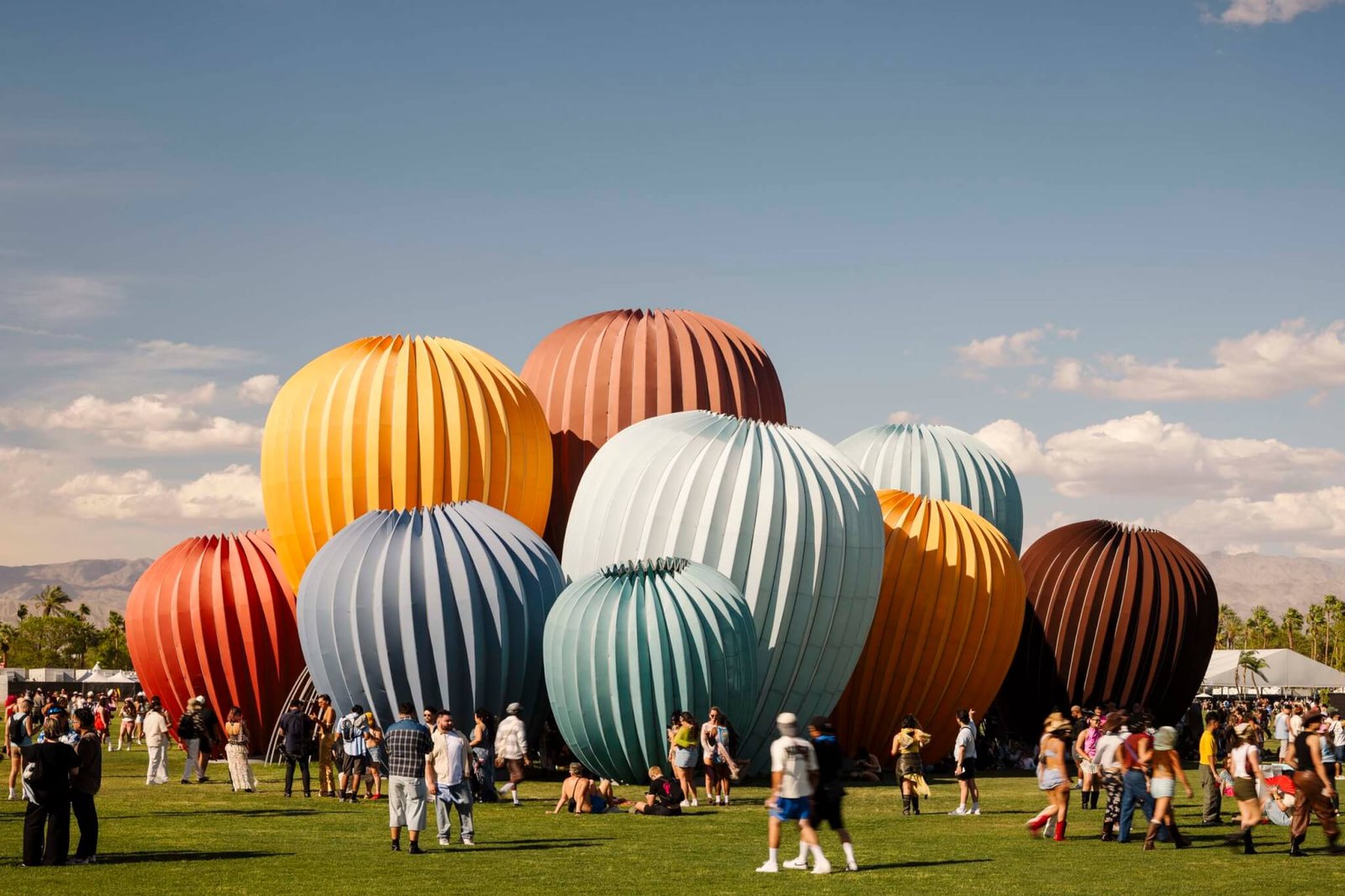
Starry Eyes, by London-based architect Kyriakos Chatziparaskevas, takes its geometry from California’s golden barrel cactus, the squat, pleated succulents that dot the Coachella Valley floor by the thousands. Chatziparaskevas’s work draws attention to the familiar plants that usually disappear into the landscape. The architect scales them up to almost 40 feet using steel ribs wrapped in brightly hued fabric that shifts from hues of terra-cotta to mustard to seafoam green. Duck inside through an opening at the base and the color swallows you—ribs of saturated fabric arching overhead toward a star-shaped oculus that frames a perfect disc of sky, a nod to the central opening in John Lautner’s Bob Hope House in nearby Palm Springs. By dusk, the spheres become lanterns, their translucent skins catch the interior light until the whole cluster pulses against the twilight. “It can’t just be an alien object,” Chatziparaskevas said. “It must belong to the place, and to the joy of the people beneath it.”


Visage Brut, by The Los Angeles Design Group (The LADG), is a soaring steel totem assembled from modular boxes—each one folded, rolled, cut, or torqued just past the point where a shipping container becomes a face. The tower stacks these warped volumes into a vertical procession of what the architects call anthropomorphic “characters,” and the effect is undeniable: portholes become eyes, a cantilevered panel juts out like a jaw, translucent burgundy and orange skins catch the sun and throw colored light through the interior like stained glass. Co-principals Andrew Holder, and Claus Benjamin Freyinger developed the piece with software-assisted steel fabricator Stud-IO Construction. As dusk settles over the valley, the tower’s mesh and metal surfaces shift from sculptural mass to filigreed lattice, its characters glowing from within.

Overhead, eight oversized kites lead 30-foot tails that spiral and flicker against the mountains. Desert Drifters Kite Club is a collaboration between London- and Los Angeles–based collective Are You Mad (founded by James Suckling and Nadeem Daniel) and French kite artist Jeanne Harignordoquy of SPF50. Each kite is a character—named things like I See You and North Star—roughly six feet tall and up to ten feet wide, with bold graphic faces designed to read from 60 meters up. Their patchworked skins are stitched entirely from deadstock textiles: ripstop, Gore-Tex offcuts, repurposed rain jackets. Part sculpture, part performance, the installation transforms the sky into a living canvas and invites festivalgoers to rediscover the simple, childlike magic of looking up.


Among the returning artists, Dedo Vabo—the partnership of Derek Doublin and Vanessa Bonet—debuts Network Operations, a new chapter in their long-running Hippo Empire series, which has appeared at Coachella since 2013. This iteration is a 3-story broadcast compound bristling with satellite dishes and red-painted radio towers, its glass-fronted rooms staffed by costumed hippo performers who run a media conglomerate of their own invention: a newspaper press clatters through fresh editions, a radio booth crackles with hippo-DJ chatter, and somewhere on an upper floor, a lone hippo powers the whole operation on a giant hamster wheel. It is absurd, frenetic, and slightly sinister—a funhouse mirror held up to the content-saturated world just outside the festival gates.
The installations are on view through April 19.