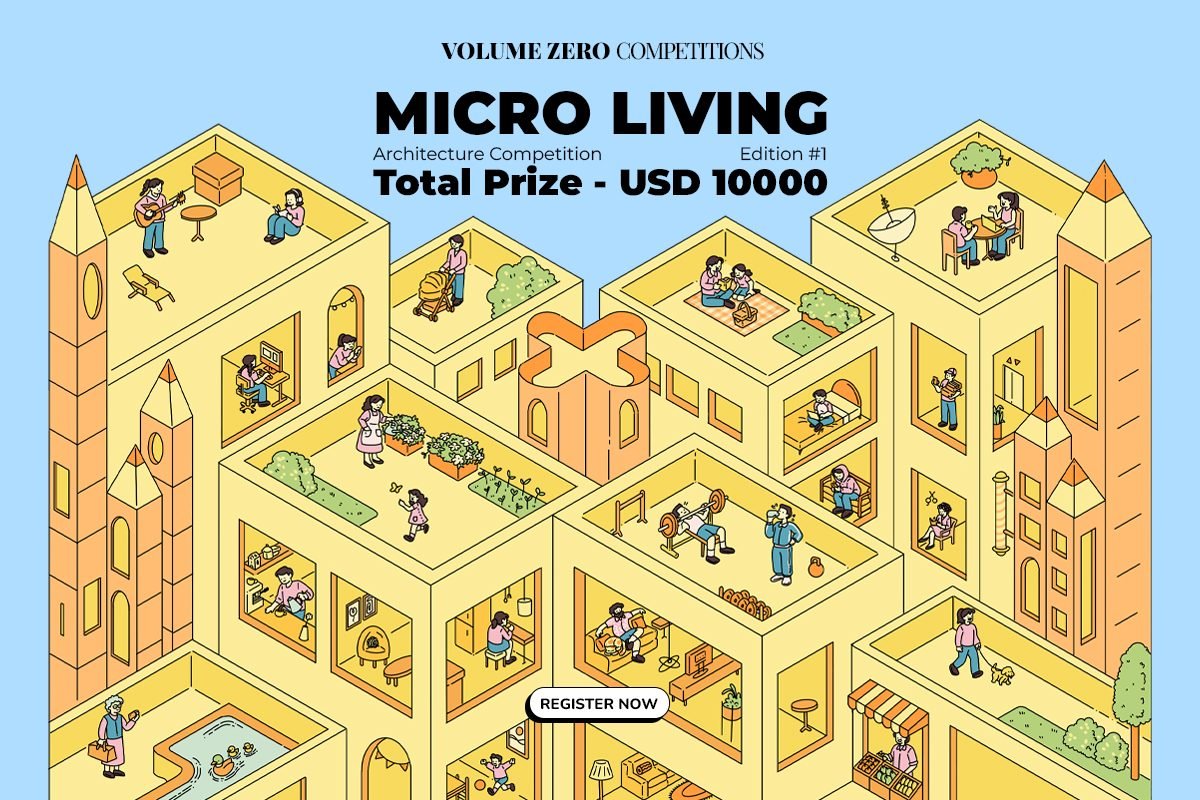
Call For Ideas: Micro Living 2026 Architecture Competition
Call For Ideas: Micro Living 2026 Architecture Competition

Marking a decade of pioneering global design discourse, Volume Zero is proud to announce the launch of its 29th international architecture competition: Micro Living 2026. This landmark edition marks a significant milestone in our 10-year journey as a “curator of potential,” continuing our commitment to a new wave of architecture that is as responsive as it is resilient.
As our world shifts toward unprecedented fluidity where we work, connect, and relocate with increasing speed the traditional rigid script of “the home” is being rewritten. Micro Living challenges the global design community to step beyond the constraints of shrinking footprints and instead expand the logic of possibility. This is an invitation to architects, designers, and thinkers to join a decade-long legacy of innovation and help us reimagine how 250 square feet can transform from a limitation into a powerful model for urban intelligence.
Come be a part of this movement; join us as we celebrate ten years of design that thinks, breathes, and evolves. – https://bit.ly/4mgKwGu
Life no longer fits into fixed rooms. We wake up to glowing screens. We work from kitchen tables. We build relationships across time zones. We relocate without warning. Climate events interrupt routines. Ownership is shifting toward access. Privacy and community now overlap in unexpected ways.
Our lives are fluid however our homes are not. Most housing is designed for stability: one job, one city, one predictable routine. Yet today, life transforms hour by hour, season by season. The way we live has evolved. The spaces we inhabit have not.
This competition asks a decisive question:
What if 250 square feet was all the city could give you?
Micro Living invites you to design more than a compact house. It asks you to reimagine the logic of living itself to transform limitation into intelligence, and density into opportunity.
“This is not about shrinking space. It is about expanding possibility.”
OPPORTUNITY:
For decades, housing has followed a rigid script. Rooms had fixed names and fixed purposes. The bedroom was for sleeping. The kitchen was for cooking. The living room was for receiving guests.
However contemporary life refuses to stay in one box. Today, a single table can host a morning meeting, an afternoon meal, and a late-night conversation. A window corner can become a studio, a meditation space, or a place to pause. Our lives are layered.
Our spaces must respond. At 250 square feet, there is no room for excess.
Every wall must think. Every surface must perform. Every movement must feel intentional.
Micro is not a compromise, it is precision. And when multiplied, precision becomes power.
“Less is More” – Mies Van Der Rohe (German-American architect)
CHALLENGE:
Design a 250 sq. ft. living module for two residents. Within this compact foot print, sleeping, cooking, bathing, working, eating, and storage must coexist not as crowded functions, but as a seamless choreography across the day.
The space should transform as life transforms. Calm in the morning. Productive in the afternoon. Intimate at night.
The module is only the beginning. Imagine 25 of these units forming a community for 50 residents in an urban context of your choice. Not a stack of identical boxes rather a responsive, adaptable network.
Circulation becomes a social thread. Shared infrastructure becomes a resource-saving backbone. Thresholds create moments of encounter without sacrificing privacy.
Design not just walls rather interdependence.
Design not just housing but a blueprint for urban resilience.
SITE SELECTION:
Participants are free to choose an urban site anywhere in the world.
From Tokyo to Mumbai, from New York to Lagos, cities are confronting density, affordability, and environmental pressure. Each context offers unique challenges and opportunities.
Select a site that strengthens your narrative. Your proposal should respond to real urban conditions and not abstract theory.
The city is evolving. Now design how we live within it.
SCHEDULE:
Headstart Registrations: 5th March 2026 to 12th June 2026
Early Bird Registration: 13th June 2026 to 4th September 2026
Standard Registration: 5th September 2026 to 6th November 2026
Closing date for Submissions: 3rd December 2026
Announcement of winners: 5th February 2027
REGISTRATION FEES:
Headstart Registrations:
Participants from India – 2700+18% GST = INR 3186 (per team)
Participants from Other Countries – 70 + 18% GST = USD 82.6 (per team)
Early Bird Registrations:
Participants from India – 3000+18% GST = INR 3540 (per team)
Participants from Other Countries – 80 + 18% GST = USD 94.4 (per team)
Standard Registrations:
Participants from India – 3500 + 18% GST = INR 4130 (per team)
Participants from Other Countries – 95+ 18% GST = USD 112.1 (per team)
Registration Opens March 5, 2026
Registration Closes November 6, 2026
Deadline to Submit Project December 3, 2026
Winners announcement Date February 5, 2027