birds become ecological loss portraits at new zealand pavilion
museum-held specimens reflect histories of ecological loss
Artist Fiona Pardington presents Taharaki Skyside, a body of large-scale photographic portraits for the Aotearoa New Zealand Pavilion at Venice Art Biennale 2026. Developed in collaboration with filmmaker and photographer Neil Pardington and curated by Felicity Milburn and Chloe Cull, the exhibition turns toward taxidermied birds held in museum collections across Aotearoa New Zealand and Australia. Through carefully staged images of endangered and extinct species, Pardington examines the intertwined histories of ecological loss, colonial collecting, and cultural memory.
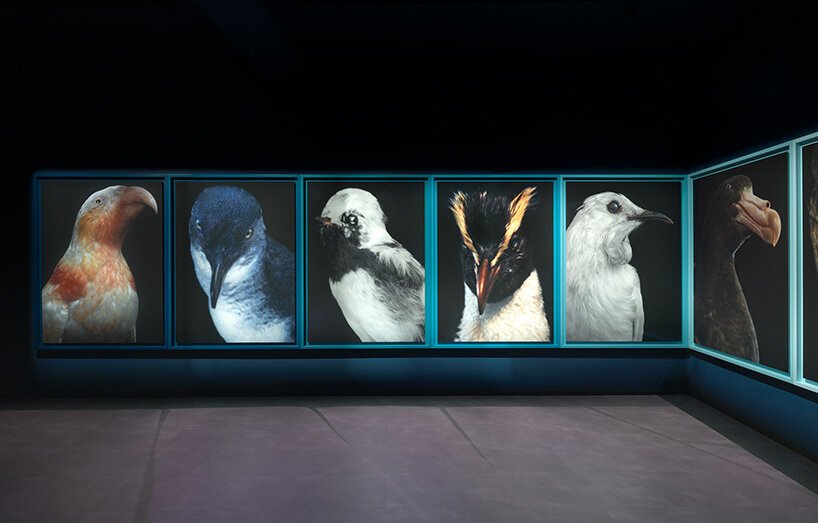
The photographs isolate each bird against dark backgrounds, drawing attention to the textures of plumage, beaks, eyes, and posture. The works depict species endemic to Aotearoa New Zealand, including the extinct huia and laughing owl, alongside critically vulnerable birds that remain under threat today. Although the subjects are museum specimens, Pardington avoids presenting them as static archival objects. Soft lighting and close-up framing give the portraits a quiet intimacy, allowing the preserved birds to feel almost alive.

installation images by Neil Pardington, bird portraits by Fiona Pardington
birds as cultural and spiritual carriers
The project builds on more than two decades of Fiona Pardington’s engagement with museum collections and photographic still life. Her practice frequently revisits taoka and natural history specimens held within institutional archives, questioning the systems through which objects, bodies, and cultures have historically been classified and contained. In Taharaki Skyside, those concerns extend toward ornithology and environmental collapse, while remaining grounded in Māori understandings of manu as spiritual intermediaries and ancestral presences.
In Māori cosmology, birds carry genealogical, ecological, and spiritual significance, acting as messengers between human and divine worlds. The exhibition title itself gestures upward toward horizons and skies, reflecting on mortality, transcendence, and connection across time.
The artist approaches birds with a sense of care and relationality. Signs of taxidermic repair, stitched feathers, and worn surfaces remain visible in the photographs, acknowledging the fragility of the specimens and the histories attached to them. The images also become records of human attempts to preserve what has already been altered or displaced.

the works depict species endemic to Aotearoa New Zealand
connecting venice and aotearoa through light and color
During a visit to Venice in 2024, Pardington observed similarities between the skies above the lagoon city and those of the Hunter Hills near Waimate in Te Waipounamu, where she lives. Together with Neil Pardington, who serves as creative director for the project, she translated those atmospheric tones into the exhibition design through softly illuminated colored frames surrounding the photographs. The installation subtly links Venice and Aotearoa New Zealand, despite their geographic distance, creating a shared visual horizon across hemispheres.
The exhibition also references Dante’s vision of the Southern Hemisphere as the location of Purgatory, approaching extinction as an ongoing condition shaped by colonization, environmental exploitation, and institutional systems of knowledge production.
Pardington’s photographs hold together themes of extinction, memory, and care with notable restraint, creating encounters that feel personal and direct. Each portrait asks what it means to look closely at beings that have already disappeared, or may soon vanish, while confronting the structures that contributed to their disappearance.
Presented at a moment of increasing global attention toward biodiversity collapse and Indigenous knowledge systems, the project situates photography as a medium capable of repair as much as documentation. Pardington’s images hold the species in a space between mourning, memory, and continued presence.

Huia, Heteralocha acutirostris, adult female, deposited 19 April 1967; collection of Canterbury Museum (AV 21,289), Ōtautahi Christchurch, Aotearoa New Zealand 2025

Tūī, Prosthemadera novaeseelandiae, albino; collection of the Museum of New Zealand Te Papa Tongarewa (OR. 026541), Te Whanganui-a-Tara Wellington, Aotearoa New Zealand 2025

Toroa, Southern royal albatross, Diomedea epomophora; collection of South Canterbury Museum (2025/078.1), Timaru, Aotearoa New Zealand 2024

Moho, South Island takahē, Porphyrio hochstetteri, probable sub-adult, Deas Cove, Thompson Sound, Te Rua-o-te-Moko Fiordland, 1851; collection of the Museum of New Zealand Te Papa Tongarewa (OR. 022236), Te Whanganui-a-Tara Wellington, Aotearoa New Zealand 2025

Tawaki, Fiordland crested penguin, Eudyptes pachyrhynchus; collection of South Canterbury Museum (2008/157.1), Timaru, Aotearoa New Zealand 2024