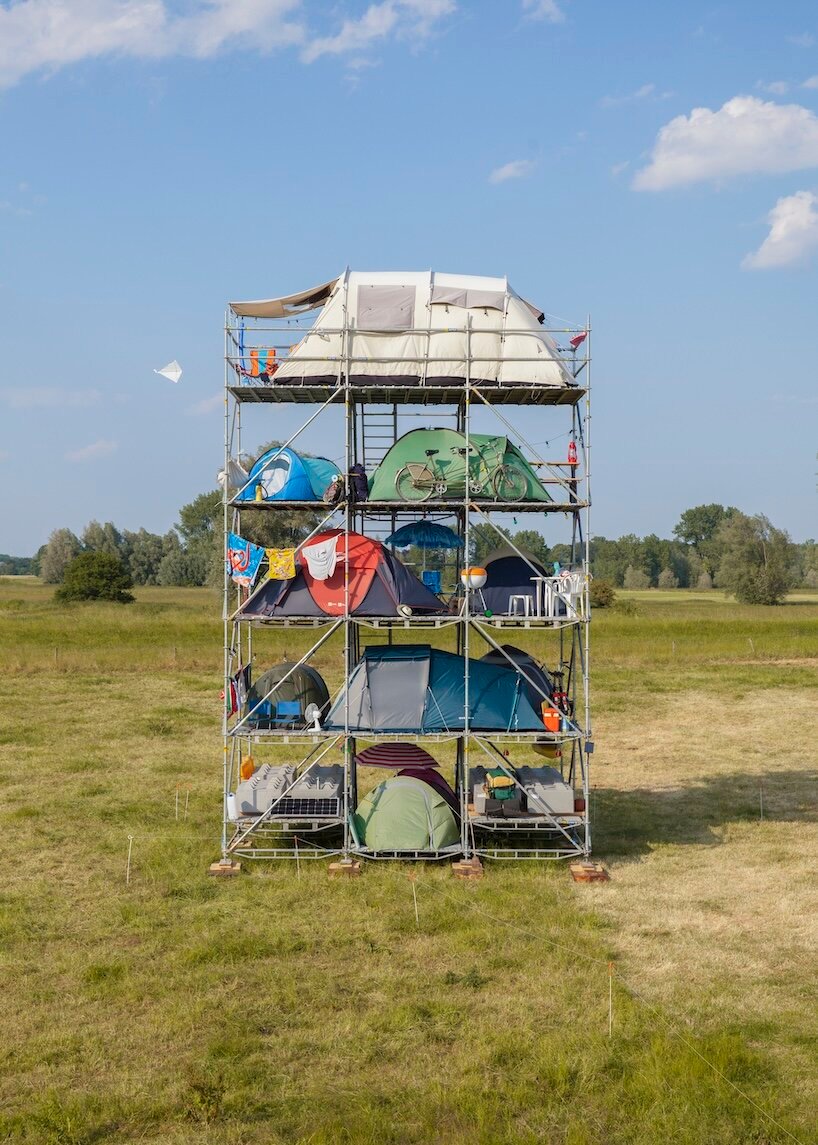
willem de haan stacks 12 camping tents into an eleven-metre tower
CAMPING GOES VERTICAL IN THE NETHERLANDS
Dutch artist Willem De Haan transforms the familiar image of a campsite into a vertical landscape with Highrise Campsite: Nature City, an installation first presented during IJsselbiënnale 2023. Rising eleven metres above the Dutch countryside, the scaffold structure accommodates up to twelve camping tents while occupying only a fraction of the ground normally required. Set beside the IJssel river, the work introduces an unexpectedly urban silhouette into an otherwise pastoral setting.
Rather than imagining the countryside as an endless open landscape, the project points to a reality where space is increasingly contested. The installation borrows its logic from the surrounding agricultural fields, where efficiency dictates how every square metre is used. Here, that same mindset is translated into a temporary campsite, stacking tents like apartments in a residential block — because apparently even escaping into nature now comes with a floor number.

Willem De Haan stacks 12 tents across an eleven-metre-high scaffolding structure | images courtesy of Willem De Haan
VERTICAL CAMPING MEETS AGRICULTURAL EFFICIENCY
The project was inspired by De Haan’s observations of local farming methods, where land is organised for maximum productivity. At the same time, tourists cycling through the region often perceive these expansive green fields as untouched and romantic landscapes. Highrise Campsite sits between those two perspectives, exposing the hidden systems of efficiency that quietly shape the environment while playfully applying them to recreational architecture.
Built from standard scaffolding, camping equipment and strings of lights, the installation deliberately avoids elaborate construction techniques. Instead, it relies on everyday materials to create a structure that feels both temporary and strangely believable. The result resembles an apartment building stripped down to its essential framework, relocating the visual language of urban development into the middle of a riverside meadow.

Highrise Campsite: Nature City rises beside the IJssel river in the Netherlands
A CAMPSITE THAT LOOKS SUSPICIOUSLY LIKE A HOUSING BLOCK
Although conceived as a sculptural intervention, the installation inevitably echoes wider conversations around land scarcity, housing pressure and increasingly dense urban environments. Without becoming overtly didactic, De Haan’s work quietly questions whether the desire to maximise every available surface eventually follows us everywhere — even to places traditionally associated with freedom, leisure and open space.
Following its debut at IJsselbiënnale, Highrise Campsite: Nature City later travelled to Amsterdam’s NDSM district, where the installation entered a very different urban context. Across both locations, De Haan continues his broader practice of inserting subtly uncanny structures into everyday landscapes, creating visual scenarios that feel simultaneously familiar, humorous and just unsettling enough to linger after the first glance.

the installation occupies a minimal footprint by arranging the tents vertically