Within a Compact Bucharest Apartment, StuffStudio Creates an Inventively Transformable Living Space
✕
Deciding what objects to hide or reveal, what possessions to store or put on display is a conundrum faced almost universally by design-minded clients. However, it is a dilemma experienced most acutely by those who inhabit small urban spaces.
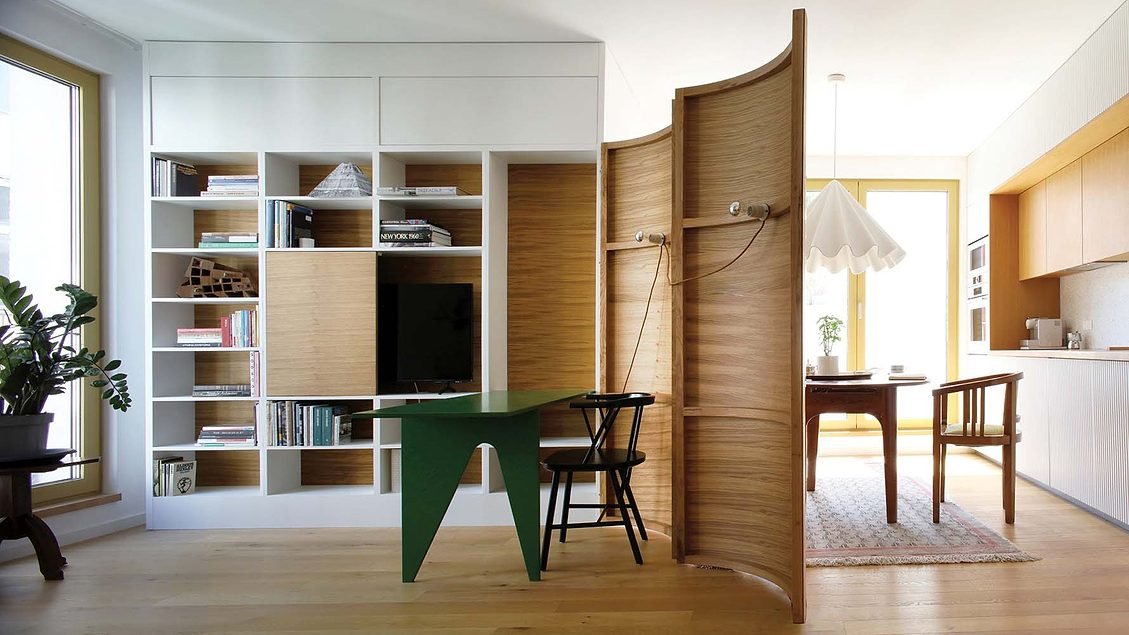
Architect Radu Remus Macovei and his practice, StuffStudio, came up with a clever response to this problem with the build-out of a compact one-bedroom apartment in a new 55-unit residential building, in a historic neighborhood of central Bucharest. Macovei—who grew up here in the Romanian capital, where he is now based—organized the 630-square-foot space for two adults, its first occupants, around a series of cabinets and closets with folding, swinging, and rotating enclosures. The operable elements not only serve to conceal or make visible the couple’s belongings, they also activate the interior. The most prominent of these transformable insertions is a 6-foot-10-inch-tall cylindrical volume, made of thin medium-density fiberboard (MDF) and veneered in oak, extending from a built-in bookcase. When open, it reveals a TV, allows for a desk to flip down, and serves as a partition between the kitchen and the main living area.

A cylindrical volume opens to reveal a TV and a desk (above and top of page). Photo © Ioana Marinescu, click to enlarge.
The inspiration, says Macovei, was a 1996 essay by Henry Urbach, appearing in the architectural-theory journal Assemblage, in which the late design critic and curator defined a concept he called the “ante-closet.” According to Urbach, the term describes the zone “extending from the inside of the closet door frame to some distance in front of the closet.” The area is “an interstitial space that appears, disappears, and reappears again and again.” For Macovei, the ante-closet is “a space of opportunity”—the place where we might select what to wear at the beginning of the day, or where we might determine what should be hidden away or exposed. In short, the ante-closet is where we negotiate how to present ourselves to others.
Though Macovei, currently a doctoral candidate and lecturer in the department of architecture at the ETH in Zurich, has extensive experience working for international practices, including Diller Scofidio + Renfro and Herzog & de Meuron, the apartment is StuffStudio’s first independent built work, with the project offering a nearly blank canvas for exploring the ante-closet concept. The unit came with little other than an oiled oakwood floor, selected by the apartment owners from options presented by the developer, and a sink and toilet in the bathroom. It had no kitchen cabinets or appliances.

Bedroom storage doubles as a headboard. Photo © Ioana Marinescu
Against a backdrop of white-painted walls over a coat of calcio vecchio (textured ornamental plaster), which the architect applied himself, Macovei made his insertions, working closely with a local carpenter to perfect finishes and devise details. The bedroom millwork, for instance, which functions both as storage space and a headboard, is made of bookmatched plywood stained green, with chamfered corners that help to disguise the thickness of its operable panels. The door of the hallway closet, hiding a washer/dryer, has a copper-toned metallic lacquer finish, the outcome of many experiments. The painted MDF kitchen-cabinet fronts, fluted to echo striations on the building’s exterior walls, have no drawer pulls or other visible hardware, enhancing a nearly monolithic appearance.

Kitchen-cabinet fluting references textures on the building’s exterior. Photo © Ioana Marinescu

Sculptural side tables bookend the sofa. Photo © Ioana Marinescu

A hallway closet door features a copper-toned lacquer finish. Photo © Ioana Marinescu

On the terrace, a hinged table flips up to become wall art. Photo © Ioana Marinescu
Many of the apartment’s features give the space a subtly cheeky air. A set of sculptural built-in side tables, for instance, in bright yellow, bookend the sofa. A semi-sheer window curtain, which when fully extended playfully jogs around a houseplant on a pedestal, includes a circular cutout that provides someone seated on the sofa a framed view of both the plant and the outdoors. Scalloped and fanlike pendant lights—some off-the-shelf and some vintage—reference the folds of the drapes and the cabinets. And, on the terrace, what first appears to be abstract wall art in painted metal—recalling Henri Matisse’s paper cutouts, says Macovei—hinges down to cover an air-conditioning unit and create a table for al fresco dining.
These smart and lighthearted touches add a bit of whimsy to the project, its theoretical underpinnings notwithstanding. Visitors need not know anything about ante-closets to appreciate this witty—but still immensely practical and highly livable—city apartment.

Image courtesy StuffStudio

Image courtesy StuffStudio
Credits
Architect:
StuffStudio — Radu Remus Macovei, principal and design lead
Client:
Withheld
Size:
630 square feet
Cost:
$25,000 (construction)
Completion:
August 2024
Sources
Cabinetwork and Woodwork:
Tudor Migia, Publimpres
Appliances:
Gorenje, Bosch
Kitchen Sink and Fittings:
Avonite, Franke Surfaces
Lighting:
TMollis, Maytoni, Audo, Hartô, Circa 1703-3071, Sertarul Magic