New York Landmarks Conservancy Among Recipients of 2025 Arthur Ross Awards
Last month, guests of the Institute of Classical Architecture & Art (ICAA) gathered for the 44th Annual Arthur Ross Awards in New York.
This year’s honorees included Hugh Petter, a director at the UK firm of Adam Architecture; New York–based interior design firm Brockschmidt & Coleman; Hank Silver, an American carpenter who led the reconstruction of the timber roof framing of the nave of Notre-Dame de Paris; Craig Bergmann Landscape Design of Lake Forest, Illinois; the New York Landmarks Conservancy, for its long-standing stewardship and advocacy work; and the British publisher, author, and critic Clive Aslet, who received the Board of Directors Honor. During the event, the ICAA also recognized two recipients of its Awards for Emerging Excellence in the Classical Tradition: Kate Chambers and Leyla Alekperova.

The timber-framed roof of Notre-Dame de Paris was reconstructed using traditional techniques. Photo © David Bordes
“The remarkable body of work produced by this year’s winners has had a monumental positive impact on individuals, communities, and the built environment,” said ICAA president Peter Lyden in a press release. “This year’s honorees are a potent demonstration of the vitality and relevance of traditional design practices today.”
The gala, held for the first time in the grand hall of the landmarked Bowery Savings Bank Building (1923), originally designed by York & Sawyer and now home to Cipriani 42nd Street, drew a record crowd of 550 attendees and raised nearly $1 million, which will support the ICAA’s educational programming. The ceremony also marked a welcome change of scenery for the institute, which had outgrown and decamped from its previous venue, the McKim, Mead & White–designed University Club on Fifth Avenue.
“Thirty-five years ago, at the start of my career, anyone who showed any interest in traditional design was, at best, seen as eccentric,” Petter said during his acceptance speech. “In the intervening period, thankfully, the world has started to move in our direction.” Petter is perhaps best known for his work for the Duchy of Cornwall; since 2003, he has been both the master planner and coordinating architect for Nansledan, a 4,000-house, mixed-use urban development, which also received the ICAA’s Gindroz Award for Excellence in Affordable Housing.

Adam Architecture looks to historic precedent when designing news houses and villas. Photo © Dylan Thomas
In his own remarks, Aslet echoed Petter’s sentiments, recalling a bleak architectural scene in 1970s Britain when he began his career. “Imagine how excited I was to discover Classical America, the magazine that heralded the organization that would become the ICAA,” he said. “Here, on the other side of the Atlantic, was a country which valued the order and delight of classical architecture. To channel Sir Winston Churchill, once again the New World was coming to the rescue of the Old,” eliciting laughs from the crowd. Aslet, who served as editor of Country Life magazine for 13 years, has authored more than 30 books and hundreds of newspaper and magazine articles about classical and traditional architecture.
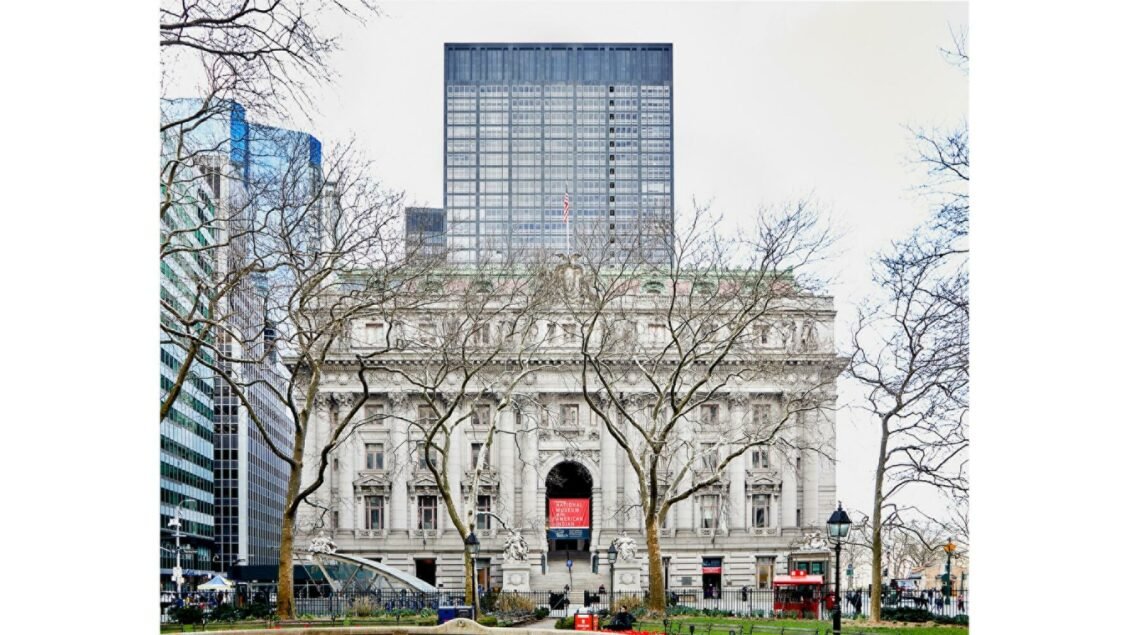
Despite an underlying jubilant tone, others fittingly took to the dais with calls to action. “Over our 52 years, we’ve worked on buildings from every layer of our architectural history and assisted diverse New Yorkers from a wide variety of backgrounds,” said Peg Breen, president of the New York Landmarks Conservancy, an organization known for its early triumph in saving the Cass Gilbert–designed Alexander Hamilton U.S. Custom House in Lower Manhattan, now home to the Smithsonian’s National Museum of the American Indian. “Preservation contributes to New York’s economy, identity, and quality of life,” Breen continued, noting the philanthropist Arthur Ross’s own instrumental contributions to restoring Astor Row, a landmark block in Harlem. She went on to sound the alarm against city and state proposals that would weaken preservation protections. “New York is worth fighting for,” she said.
Indeed, there remains a great deal of debate within the profession about the role of preservation and the value of contemporary classicism. The presence of other classically oriented awards, such as the University of Notre Dame’s Driehaus Prize, inaugurated in 2003, as well as of several practices that have found continued success in exercising a traditional approach to design, including Robert A.M. Stern Architects (RAMSA), Ferguson & Shamamian, and Peter Pennoyer Architects, suggest a sustained appeal. These issues were also thrust, once again, into a politically charged spotlight following President Trump’s mandate, “Promoting Beautiful Federal Civic Architecture,” which he signed earlier this year as a redux of sorts to an order made during the waning days of his first term.
Notably, the ICAA opposed the first dictate in 2020. “The prospect of new civic buildings and public places built in the classical language would ordinarily be cause for optimism and celebration,” the institute’s statement read, highlighting the legacy of American neoclassical structures by the likes of Benjamin Latrobe, John Russell Pope, Gilbert, and others. “A government edict is not just the wrong approach, but is counterproductive to the ICAA’s goal of celebrating classical architecture and building support for its principles, merits, and potential.” Welcoming enthusiastic new members each year and introducing them to a broad slate of educational opportunities—lectures, intensive courses, and scholarly books—has been one of the many ways that the ICAA has sought to advocate from the ground up. Celebrating talent through the Arthur Ross Awards has been another.
Established in 1982 by Ross and the architecture critic Henry Hope Reed, the awards have recognized the achievements of architects, artists, craftspeople, designers, educators, and patrons dedicated to “preserving and advancing the classical tradition.” This year’s winners were selected by a jury chaired by Andrew Cogar, president of Historical Concepts, and including Elizabeth Graziolo of Yellow House Architects, Siobhan Kelly of David Collins Studio, James McCrery of McCrery Architects, Donald Powers of the Urban Guild, Adrian Taylor of Hyde Park Mouldings, and Thomas Woltz of Nelson Byrd Woltz.