
The Mona Lisa: Spatial and Mythological Tension Between Florence and Paris
Architectural & Cultural Analysis
How Leonardo da Vinci’s portrait evolved from a Florentine domestic painting into a global icon reshaping the architectural space of the Louvre
By Ibrahim Fawakherji Architectural Writer & Editorial Analyst at ArchotJuly 30, 2026
Before standing in the Salle des États at the Louvre in front of the most visited painting in history, I stood on Via della Stufa in Florence, outside the stone building where Lisa Gherardini once lived. Far from the museum spotlight, a spatial reality becomes clear: the Mona Lisa is not merely a painting, but a sequence of physical and cultural displacements that detached material from its urban roots to construct a global myth.
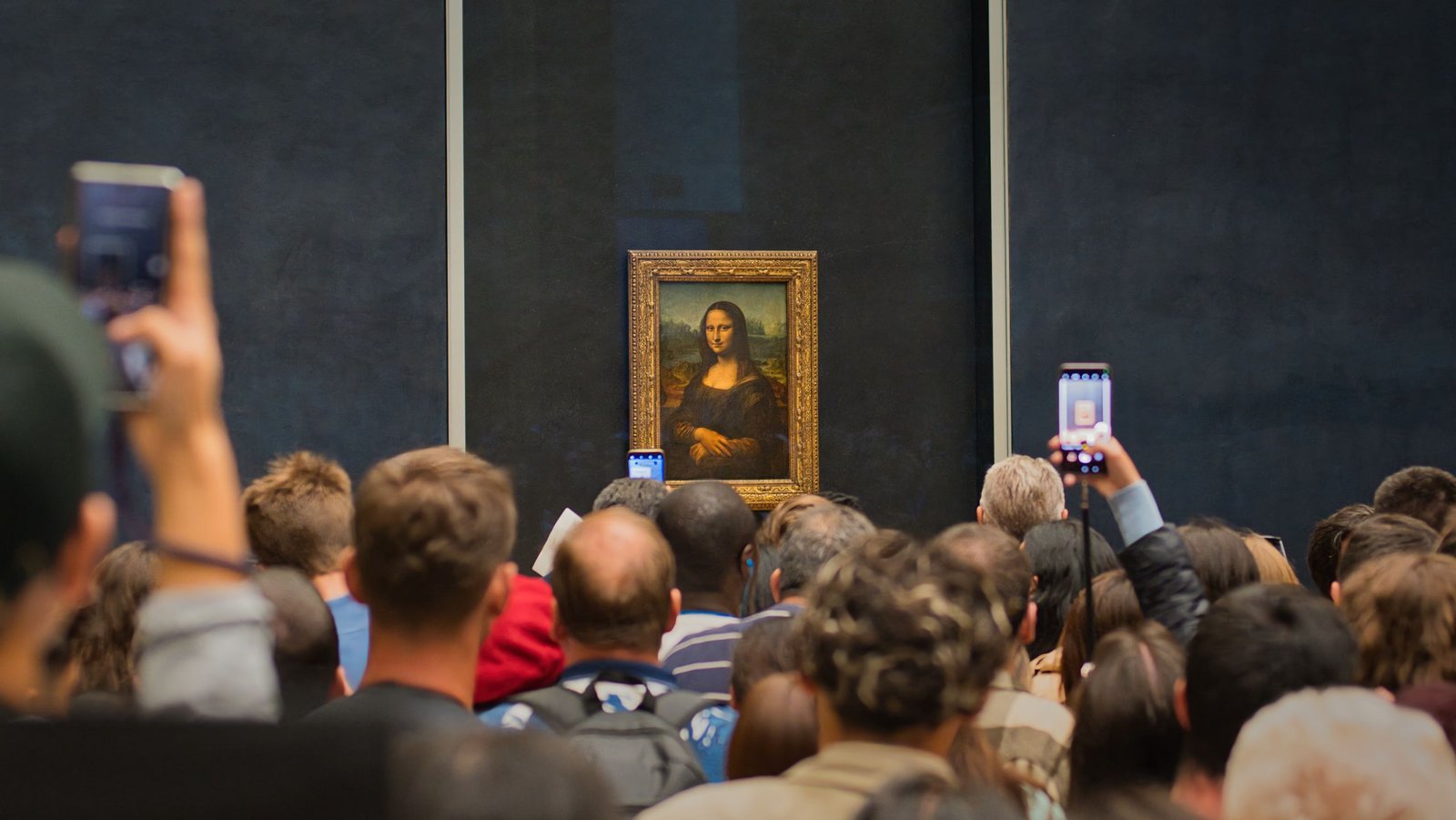
 Displaying the Mona Lisa requires advanced architectural barriers for protection and organized queue management protocols.
From Florence to Paris: The Displacement of Matter and Roots
Leonardo da Vinci began painting the portrait around 1503, commissioned by Francesco del Giocondo to mark the birth of their child. Leonardo never delivered the work; instead, he carried it with him to France in 1516, where it eventually entered the French Royal Collection. Lisa Gherardini died in 1542 and was buried in the Convent of Saint Ursula in Florence, while her likeness continued to reshape the spatial memory of Paris—moving from Napoleon’s bedroom to its current sanctuary in the Louvre.
“The woman in the portrait lived and was buried in Florence, but the myth she became lives and breathes within the architectural void of Paris.”
The 1911 Theft: When Absence Constructs Myth
Technical mastery alone did not generate this unprecedented global fame. The pivotal catalyst was the 1911 theft by Vincenzo Peruggia. For two years of absence, crowds flocked to the museum simply to gaze at the empty wall space and remaining hooks. The absence generated a media sensation that eclipsed the physical artwork itself, transforming a Florentine portrait into an irreplaceable cultural icon.
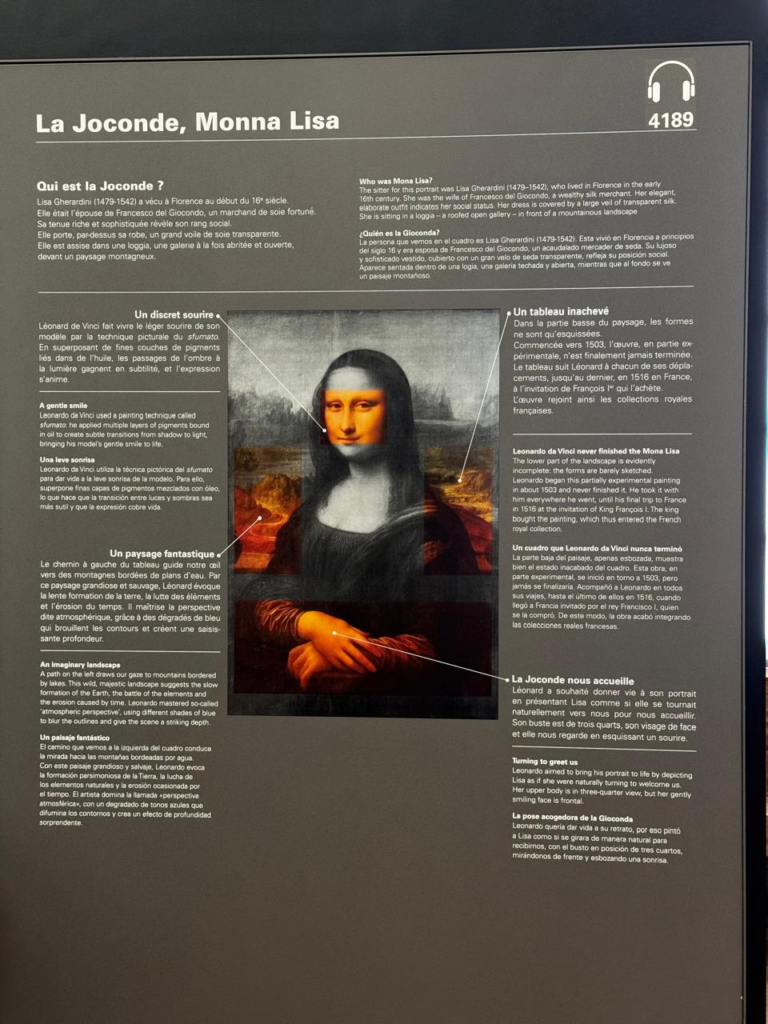 Multilingual educational infrastructure provides crucial historical context and visual analysis for Da Vinci’s masterpiece.
Cultural Gravity and Architectural Spatial Pressure
Bluetooth movement-tracking data inside the Louvre reveals a striking reality for museum architects: a modest wood panel measuring 77 × 53 cm, protected behind bulletproof glass, dictates the primary circulation pattern within a 72,000-square-meter exhibition complex.
In the Salle des États, the Mona Lisa hangs directly opposite Paolo Veronese’s The Wedding at Cana—a massive 70-square-meter canvas designed to dominate the room. Despite the immense scale difference, most visitors turn their backs on Veronese’s monumental work to crowd around the small enclosure. Here, cultural narrative completely overrides spatial scale and architectural intent.
The Mona Lisa demonstrates that physical space is inherently neutral; it is the collective projection of narrative that distorts spatial and economic realities. The Louvre is not merely an art museum in the traditional sense, but an architectural container organized around a single narrative node that continuously challenges crowd dynamics and spatial planning.
About the Author: Ibrahim Fawakherji
Ibrahim Fawakherji is an architectural critic and editorial analyst at Archup. His work focuses on the intersection of urban philosophy, cultural heritage, and the evolving relationship between the built environment, collective memory, and contemporary technology.