
✕

In the fall of 1804, Meriwether Lewis and William Clark passed through what would become North Dakota, following the Missouri River north and west. “Saw Buffalow Elk and Great numbers of Goats in large gangues,” wrote Clark in his journal on October 17. Their expedition was passing through what is now Emmons County, just south of Fort Mandan, where a few weeks later they would meet Sacagawea, a Shoshone woman living with the Hidatsa tribe who became the team’s translator and guide to the challenging terrain.
Renaturalizing this land, recently used for cattle grazing, to the condition Lewis and Clark might have experienced is the ongoing project of Spoonbill Ranch’s owner, who has accumulated close to 8,000 acres in the undulating landscape of Emmons County, an area known for its “prairie potholes.” Created as glaciers receded, the pothole-like ponds seasonally capture melting snow and rain, transforming the topography into wetlands just in time to welcome vast numbers of migratory birds like the property’s namesake spoonbill. Buffalo no longer roam, but elk, deer, and coyotes share the land with the waterfowl.
1
2
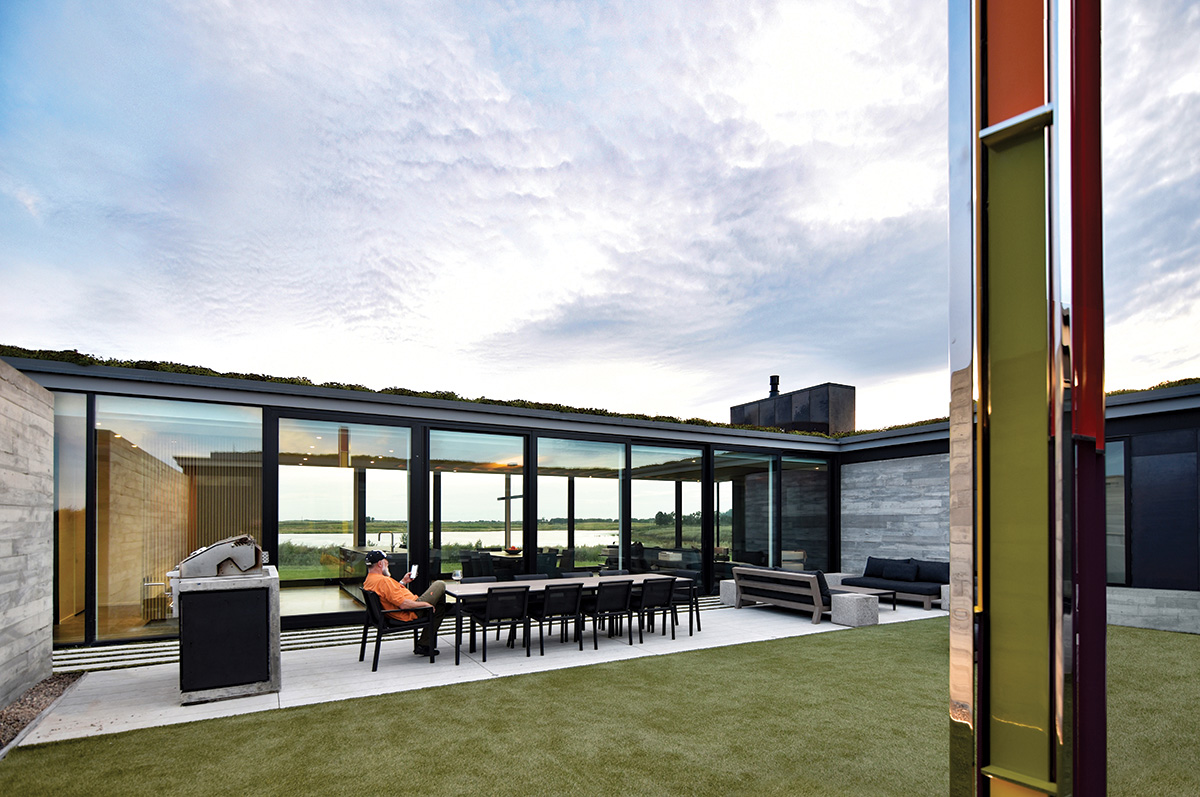
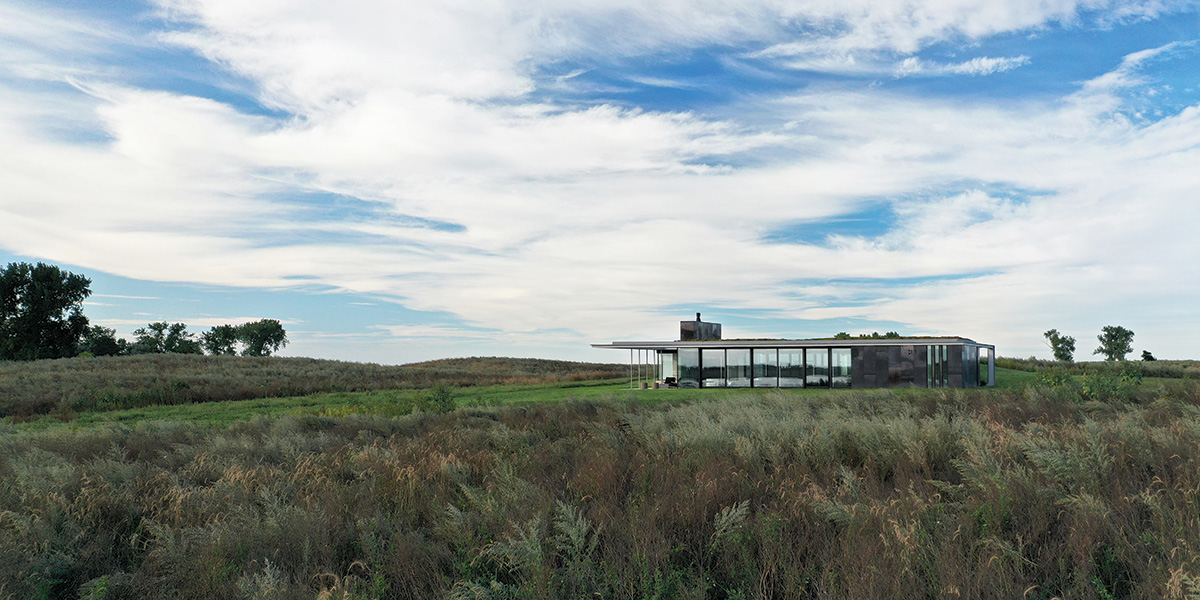
Glazing around the exterior (1) and the courtyard (2) allows continuous views. Photos © John J. Macaulay
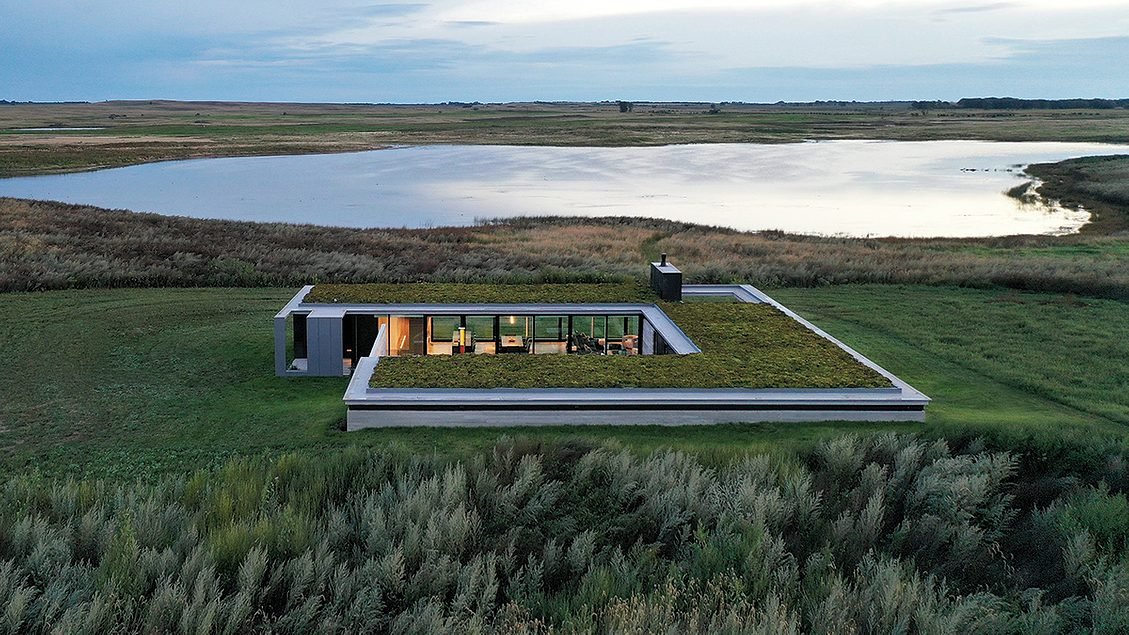
Sunk into a gentle hill facing a pothole pond, a low-profile residence offers an ideal view of the natural drama while remaining largely camouflaged. The Spoonbill Ranch house sits isolated, a 30-minute drive into the property with a parking area almost a quarter mile from the front door. Beyond the pristine landscape, the owner “didn’t want to see things outside the house,” says Brian Johnsen, principal at Milwaukee-based Johnsen Schmaling Architects (a 2011 Design Vanguard) and designer of the 3,360-square-foot residence.
The siting of the house, plus its green roof and razor-thin profile, makes it almost invisible from certain perspectives. “We envisioned the house being tucked into the landscape as much as possible, taking advantage of the knolls,” says Johnsen. A simple courtyard plan creates a living space with two vistas: the windswept plains outside and a cultivated garden area within, protected from harsh gusts. “We wanted to make a visual link between the courtyard and the pond to make sure that the central living hall was connected to the landscape.”
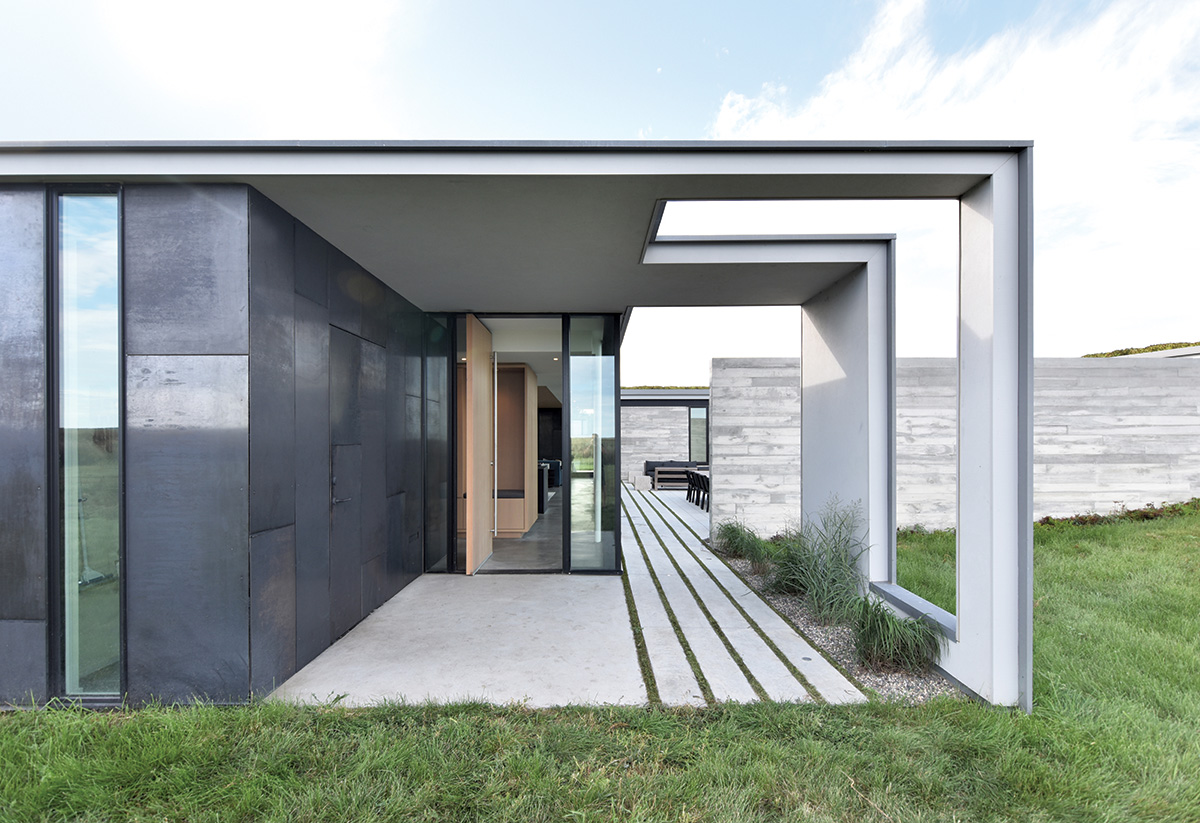
Board-formed concrete walls provide durability as well as insulation in the region’s extreme winter cold and summer heat, as do the triple-glazed windows and lift-slide doors. Black-oxide steel panels on the exterior create contrasting texture and color variegation along the facade, adding to the camouflage effect while retaining a natural, minimalist aesthetic. A patio with an outdoor fireplace at the southwest corner features sunset views as well as an overhead frame for evening stargazing, thanks to a cutaway in the roof.
3
4
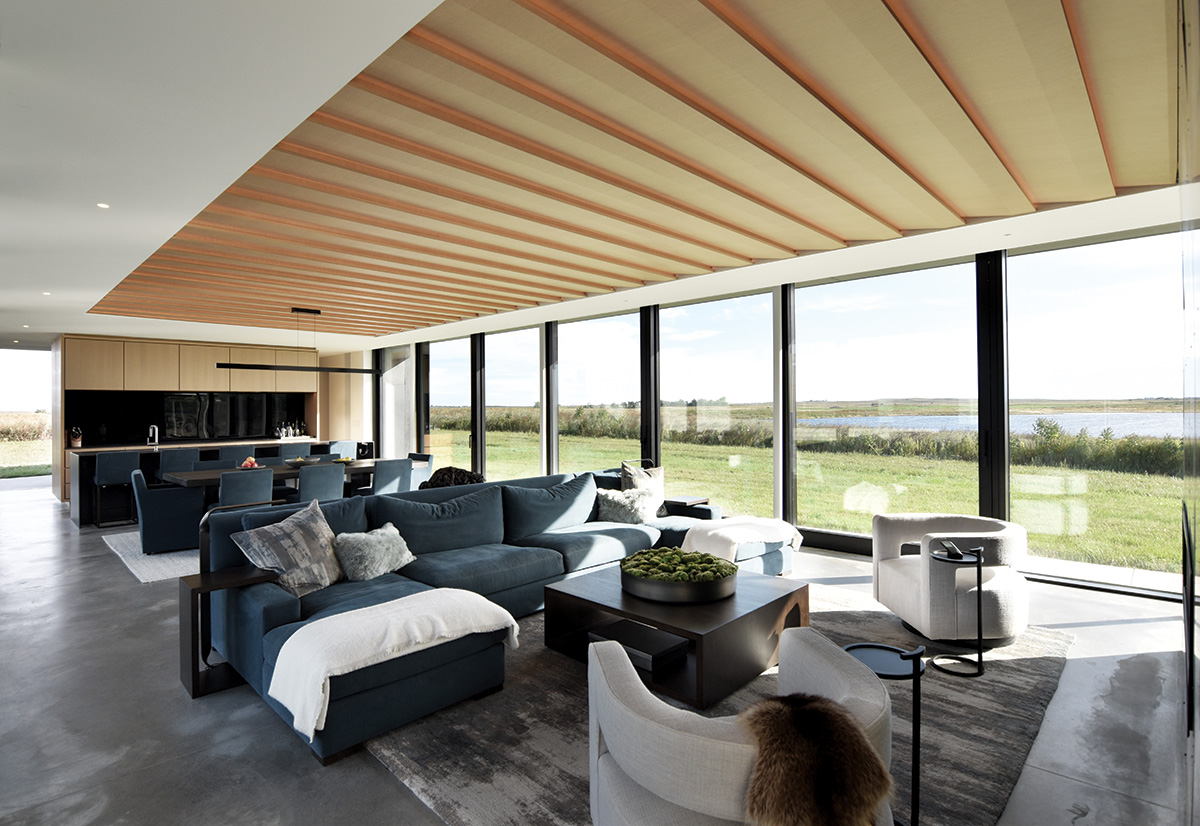
Steel panels (3), concrete floors, and oak woodwork (4) create an urbane feel. Photos © John J. Macaulay
Inside, a scalloped wood ceiling adds warmth to the open-plan living area finished with a poured concrete floor and white walls. Wood kitchen cabinetry frames a dark polished backsplash that reflects the outdoors. “You never feel like you’re not connected with the outside,” notes Johnsen. Four bedrooms ring the courtyard, and a sauna plus a concrete-topped tornado shelter sit under the berm side. Everything can operate off-grid, powered by an out-of-view photovoltaic array and geothermal heating-cooling system.
Though resolutely remote and private, the house has an inviting open entry to the courtyard on its eastern side, where the roof recedes to allow maximum morning sunshine. There, the owner asked the architects to create an artwork. “The space in the courtyard is limited, so we wanted something with a minimal footprint but that was counter to the horizontality of the house,” says Johnsen of the firm’s first fine art commission. The 15-foot-tall stainless-steel sculpture with colored panels was inspired by “the spectacular bloom of prairie flowers, the kaleidoscope of colors that hits in late spring.”
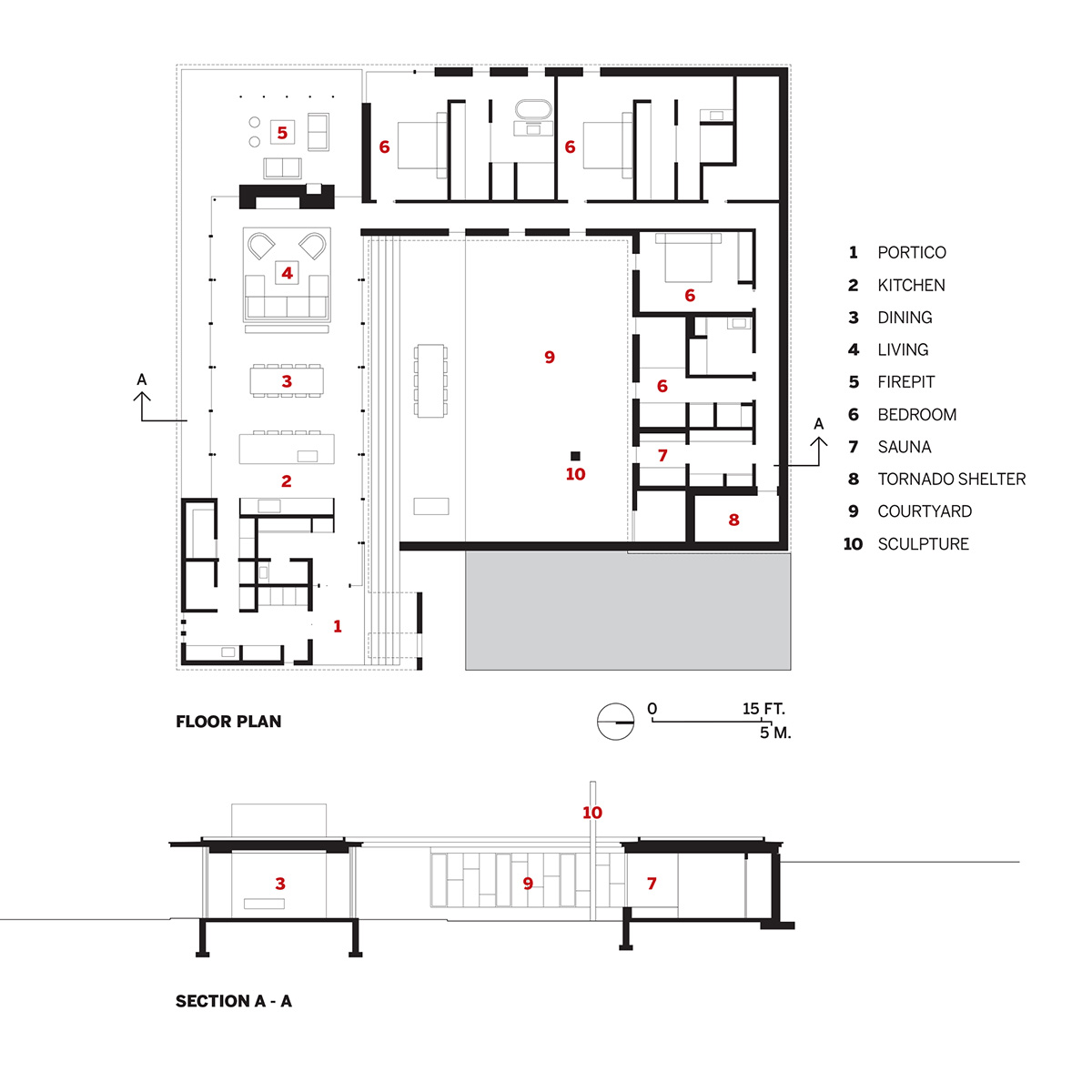
Image courtesy Johnsen Schmaling Architects; click to enlarge
Credits
Architect:
Johnsen Schmaling Architects — Brian Johnsen, Sebastian Schmaling, Andrew Cesarz, P.J. Murrill, Ben Penlesky, Angelina Torbica, Matt Wendorf
Engineers:
Core 4 Engineering (structural)
Consultant:
Design Fugitives (sculptural)
General Contractor:
Paramount Builders
Client:
Jeff Mudge
Size:
3,360 square feet
Cost:
Withheld
Completion:
September 2024
Sources
Metal Panels:
Wiemann Metalcraft, Alpolic
Stucco Soffits
Sto
Moisture Barrier:
Huber
Doors:
Quantum
Locksets:
Inox, Rixson
Wall Tile:
Daltile
Lighting:
Pure Edge, BEGA, WAC, Lutron