
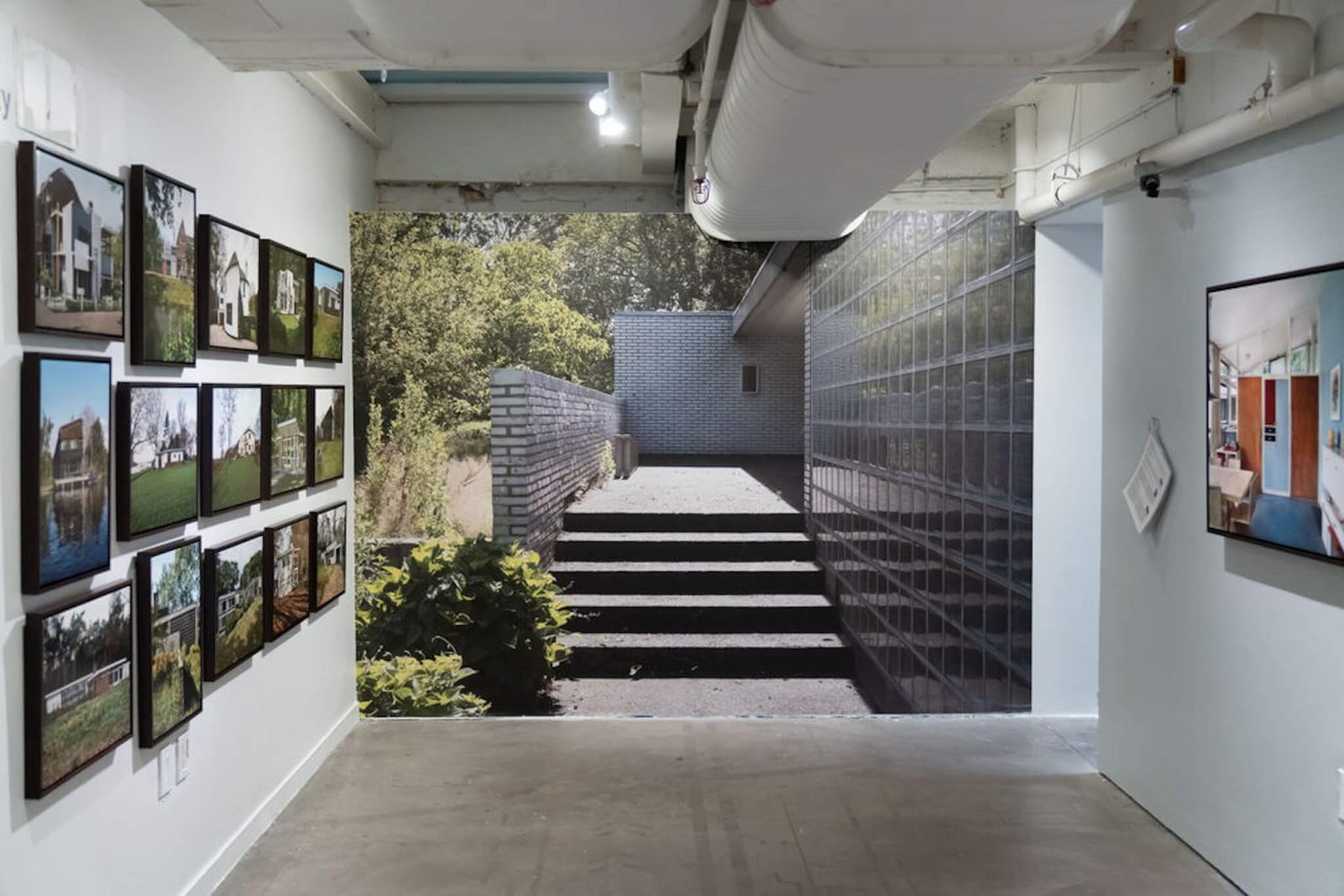
An exhibition at the Center for Architecture showcases photography by Arjan Bronkhorst, who spent two years locating and photographing 15 houses designed by Gerrit Rietveld. Bronkhorst curated the show with architectural historian Barry Bergdoll.
Gerrit Rietveld: Wealth of Sobriety stems from Bronkhorst’s 2018 monograph of the same name. Rietveld designed nearly a hundred houses over four decades, but most of them were private commissions that received little public attention.
In a statement Bergdoll said, in describing the exhibition which sheds light on these lesser known works, “Bronkhorst’s photographs bring us into contact with the world of Rietveld owners who have carefully protected his many residential designs.”

The exhibition’s title is derived from a statement Rietveld made late in his career, urging people to reject extravagance and instead “find joy in the wealth of sobriety.”
Bronkhorst’s photographs reflect that sentiment by directing attention toward window latches, stair treads, the effects of light on unfinished wood, and more quotidian facets of Rietveld’s designs.
“Rietveld was unwavering when it came to the aesthetic design of his houses,” said Bronkhorst. “As a photographer, I am inspired by the clarity of Rietveld’s designs and the sober genius of his interiors.”
One photograph taken inside the Schröder House shows Rietveld’s 1922 hanging lamp. A separate image isolates the Zig-Zag chair, its angular seat lit by a shaft of afternoon sun.
A third photograph—taken at a house in Ilpendam, Holland—depicts a wall-mounted lamp fixture of white crossbars and hanging rods set against a saturated cobalt wall, positioned so the fixture’s shadow echoes its own geometry.

The interior photographs also depict the current residents of these houses, a feature not typical of architectural photography. Bronkhorst has previously applied this approach in his books on Amsterdam canal houses and Dutch church interiors, and it appears here in a portrait of an elderly resident seated at a wooden table, among other scenes.
Elsewhere, a child sits wrapped in a blanket on a weathered porch, and a homeowner is shown walking past a red accent door on a concrete facade. The houses remain legible as architectural objects while also registering as inhabited spaces.

A separate section of the exhibition is devoted to the Parkhurst House in Wakeman, Ohio, Rietveld’s only detached house built outside the Netherlands.
Charles Percy Parkhurst, a former Oberlin College art history professor, commissioned the house in the late 1950s after meeting Rietveld while researching his work. The house occupies a wooded site above the Vermilion River and consists of a rectilinear volume with a flat roof and a floor-to-ceiling glass wall.

Rietveld never saw the completed Parkhurst House. He had been denied entry to the United States in 1955 due to alleged communist sympathies, and Parkhurst oversaw construction himself, adjusting the design over the course of the project.
Bronkhorst’s photographs of the house, taken in autumn, document how the house has changed including a weathered yellow panel, a fireplace darkened by decades of use, and furnishings that depart from Rietveld’s original design.
“To see Rietveld’s architecture, exterior and interior, through the lens of Bronkhorst’s camera is to enter into dialogue with the geometric composition of his spaces, but also to see patterns both within a space and across a career,” Bergdoll added.
Bergdoll continued: “If Rietveld praised the ‘wealth of sobriety,’ it has been a Rietveldian exercise for us together to distill a sampling of the hundreds of photographs Bronkhorst has taken to craft a vision of the language of the Dutch modernist’s design sensibility.”
Gerrit Rietveld: Wealth of Sobriety is on view at the Center for Architecture through September 2.
(function (d, s, id) {
var js, fjs = d.getElementsByTagName(s)[0]
if (d.getElementById(id)) return
js = d.createElement(s)
js.id = id
js.src="https://connect.facebook.net/en_US/sdk.js#xfbml=1&autoLogAppEvents=1&version=v3.1&appId=237336769628829"
fjs.parentNode.insertBefore(js, fjs)
}(document, 'script', 'facebook-jssdk'))
!function (f, b, e, v, n, t, s) {
if (f.fbq) return
n = f.fbq = function () {
n.callMethod ?
n.callMethod.apply(n, arguments) : n.queue.push(arguments)
}
if (!f._fbq) f._fbq = n
n.push = n
n.loaded = !0
n.version = '2.0'
n.queue = []
t = b.createElement(e)
t.async = !0
t.src = v
s = b.getElementsByTagName(e)[0]
s.parentNode.insertBefore(t, s)
}(window, document, 'script',
'https://connect.facebook.net/en_US/fbevents.js')
fbq('init', '758169134333166')
fbq('track', 'PageView')