Celeste Dupuy-Spencer, Artist Who Confronted Injustice, Dies at 46
Celeste Dupuy-Spencer, a painter who confronted injustice at home and abroad with striking scenes of resistance, died on Friday, April 10, at the age of 46 at her home in Los Angeles, days before the opening of a new solo exhibition of her work at Jeffrey Deitch’s West Hollywood gallery. The cause of her death was not publicly reported, and the gallery is expected to make an announcement about her show and a memorial in the coming days.
Deitch, whose gallery announced the news of her death on Saturday, said Dupuy-Spencer was “beloved by people in her creative community.”
“Celeste was an extraordinary artist and a wonderful person, deeply dedicated to her painting, often working round the clock in her studio,” Deitch wrote in an email to Hyperallergic. “We spent many hours in her studio talking about the history of art and how it intersects with world events.”
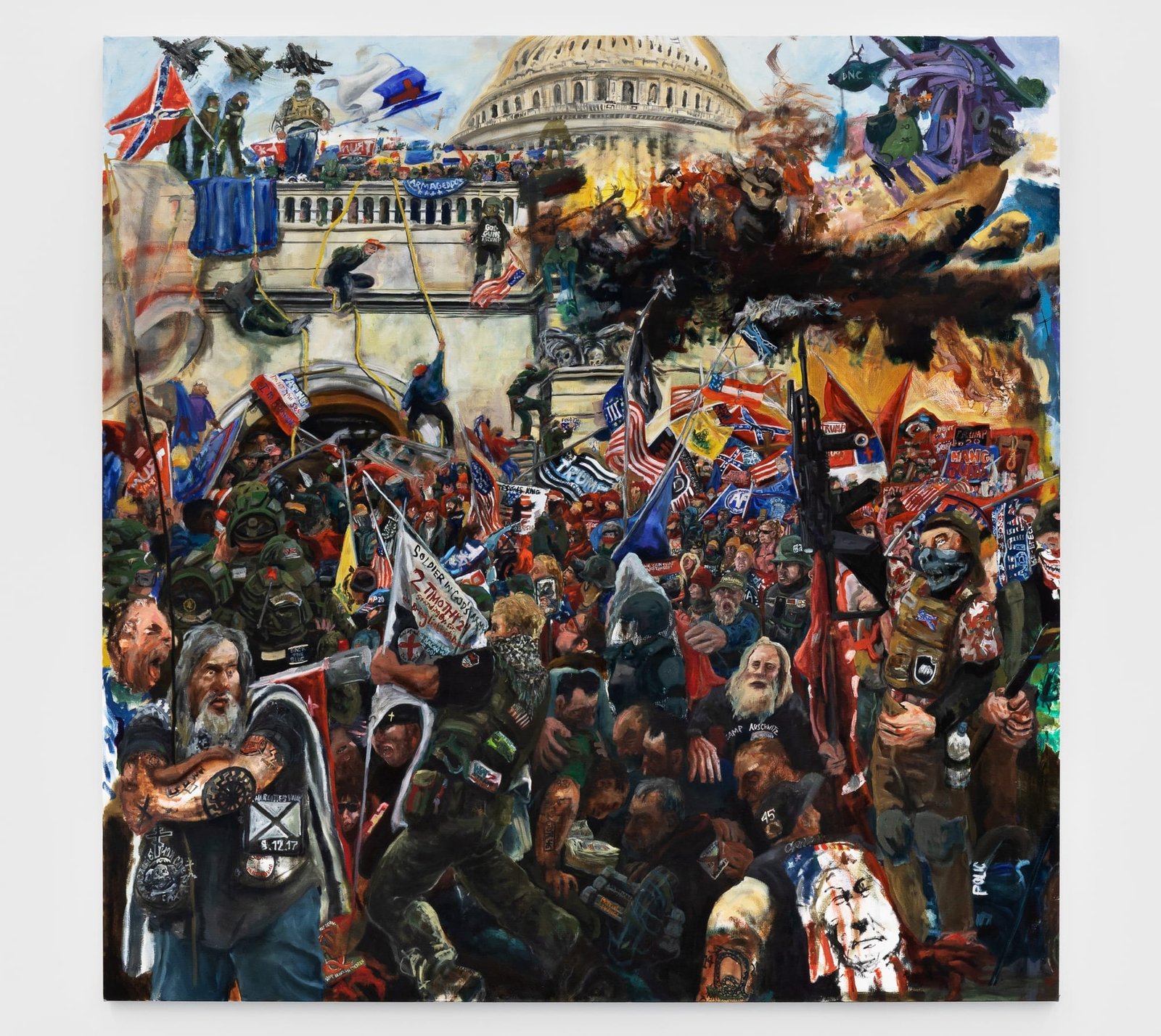
Celeste Dupuy-Spencer, “Father, Don’t You See That I Am Burning” (2021) (photo Dawn Blackman, courtesy the artist)
The California-based artist deconstructed violent moments of contemporary American politics in her work. Her vivid depiction of the January 6 insurrection, “Father, Don’t You See That I Am Burning” (2021), was acquired by the Hirshhorn Museum and Sculpture Garden in Washington, DC, in 2022.
Dupry-Spencer also spoke in opposition to the atrocities Israel committed against Palestinians in Gaza and the Occupied West Bank. She was the target of relentless pro-Israel online harassment from the art world and beyond, but she continued to defend her stance in solidarity with the human rights of Palestinians.
“I’m proud to be included on the list of people who stopped everything to cry out for an end to the genocide and a free Palestine,” she posted on her Instagram page in September. “I don’t care what they do to me. Why would I duck and hide from fascists?”
“To call a Jewish person a token for speaking against the state — that is anti-Semitism,” she wrote.
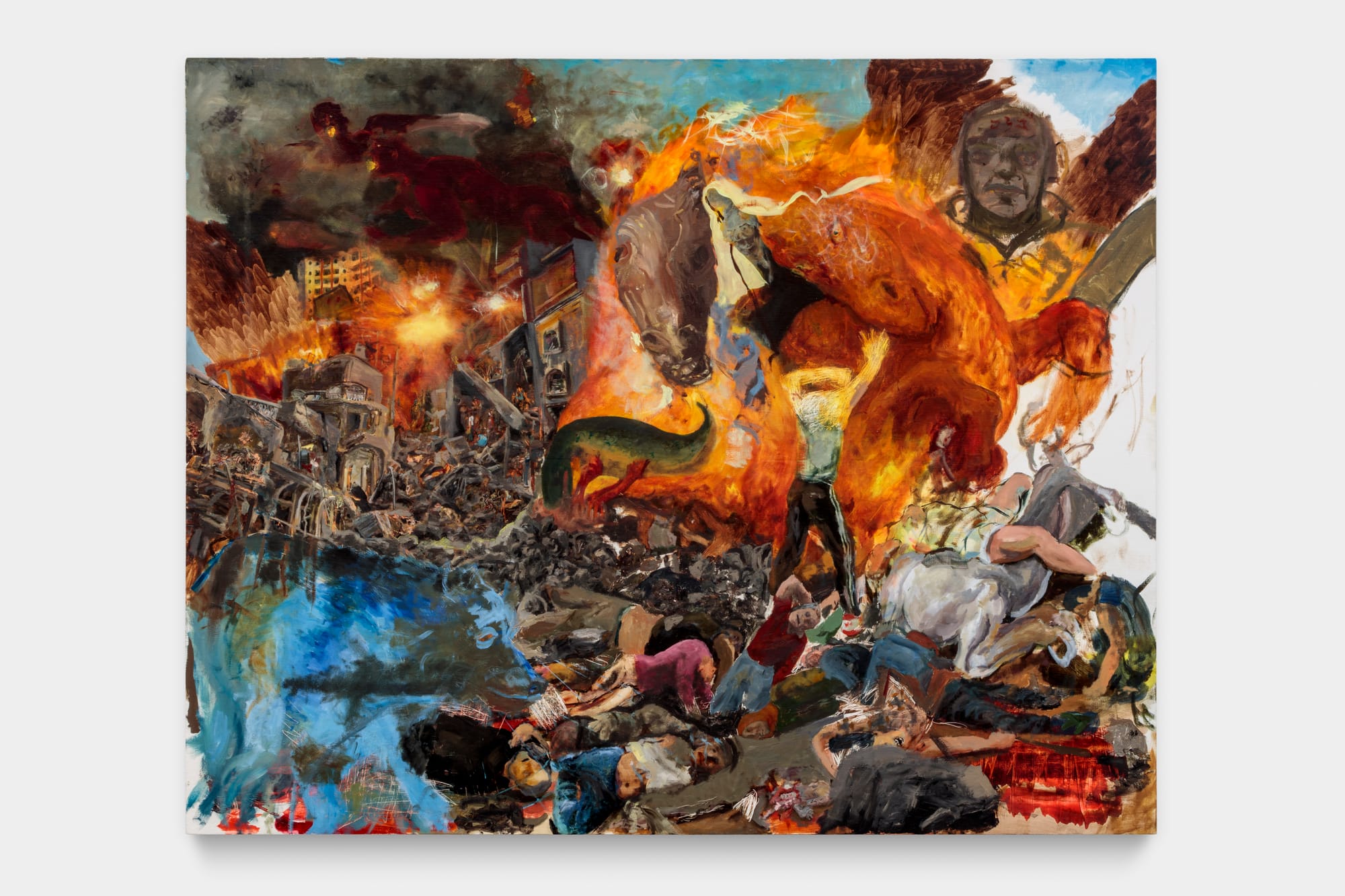 Celeste Dupuy-Spencer, “The Alchemist, the Gospel, the Pillar of Fire (The Showcase)” (2024) (photo Charles White – JW Pictures, courtesy the artist and Jeffrey Deitch, New York and Los Angeles)
Born in 1979, Dupry-Spencer grew up in Rheinbeck, New York, and traveled frequently to Louisiana before pursuing a Bachelor’s of Fine Arts at Bard College in 2007 without graduating. She moved from New York to New Orleans in 2012 but eventually settled in Los Angeles, showing at Nino Mier Gallery and Eve Fowler’s Artist Curated Projects.
A decade after college, Dupry-Spencer found acclaim when her paintings were featured in the 2017 Whitney Biennial and the Hammer Museum’s 2018 Made in LA biennial. She reportedly contemplated shelving her art career while in New Orleans, but the experience of living in the Deep South inspired her to explore the origins of American mythologies and their reach into the present.
“Our relationship to that stuff is so twisted…It’s…desperately trying to be like, ‘that has nothing to do with me’ — when in fact it has everything to do with you,” she told Pelican Bomb’s Hyunjee Nicole Kim after refusing to attend a family’s wedding at a historic plantation.
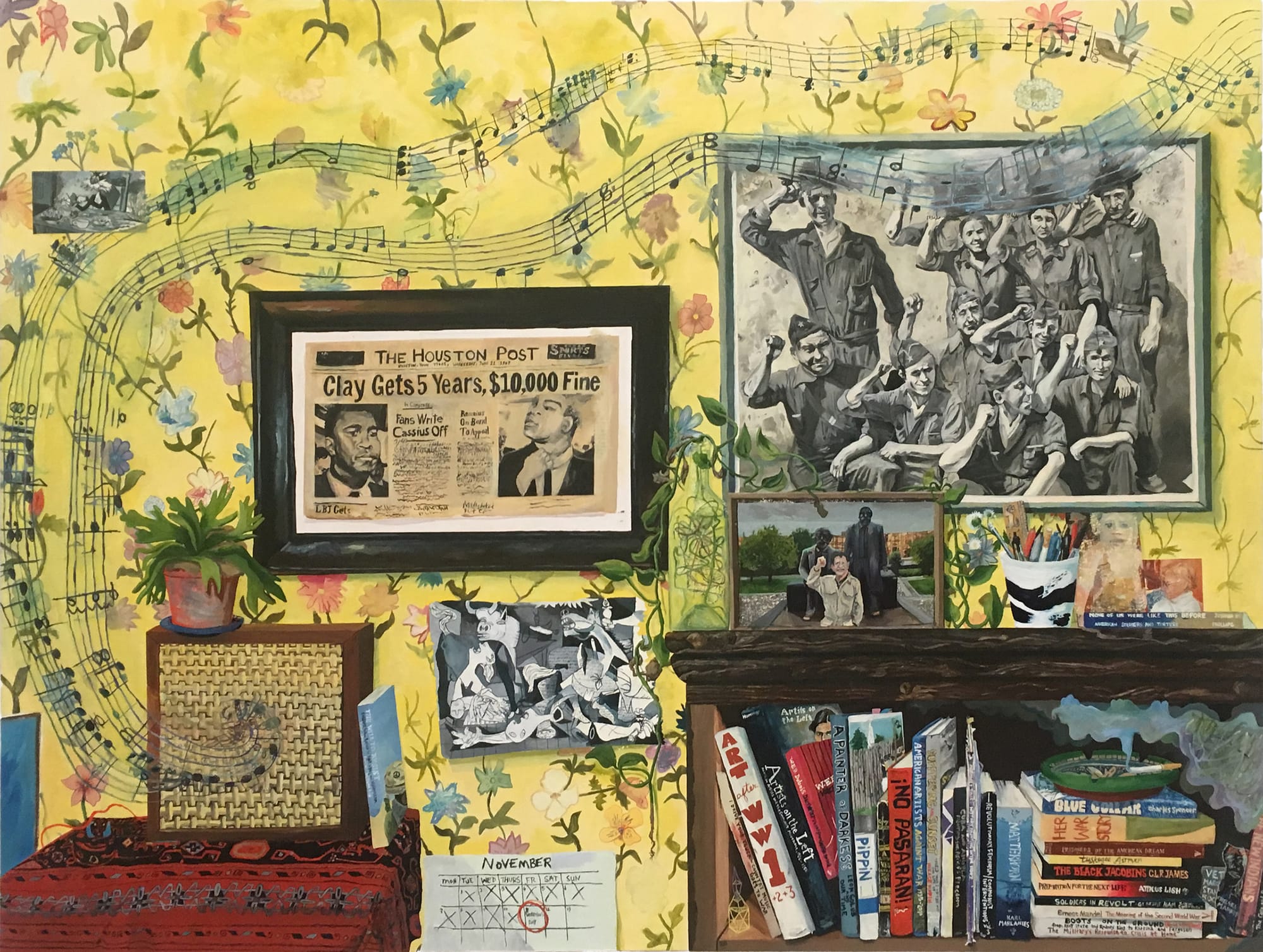 Celeste Dupuy-Spencer, “Veterans Day” (2017) (courtesy the artist and Whitney Museum of American Art)
In 2021, Dupuy-Spencer became transfixed following Democracy Now! and CNN reports of MAGA activists ransacking the US Capitol as Congress certified the 2020 election. She first resisted painting the scene, but chose to depict the chaotic images of QAnoners, Proud Boys, and other camo-clad rioters with references to Caravaggio, Thomas Cole, and James Ensor’s “Christ’s Entry into Brussels in 1889” (1888) and Tintoretto’s “Moses Drawing Water from the Rock” (1577).
As she became more well-known, Dupuy-Spencer began speaking about her identity as a trans, masculine-presenting person while never seeing herself as fully male or female. (Dupuy-Spencer did not like using specific pronouns, but went by she/her in interviews.)
“I don’t consider myself transitioning to male, but I was starting to do that and found myself reacquainted with something that I really love in myself — the feminine side that was in a constant state of suppression,” she told Los Angeles Magazine in a 2021 profile. “Being trans allowed me to understand what femininity really was.”
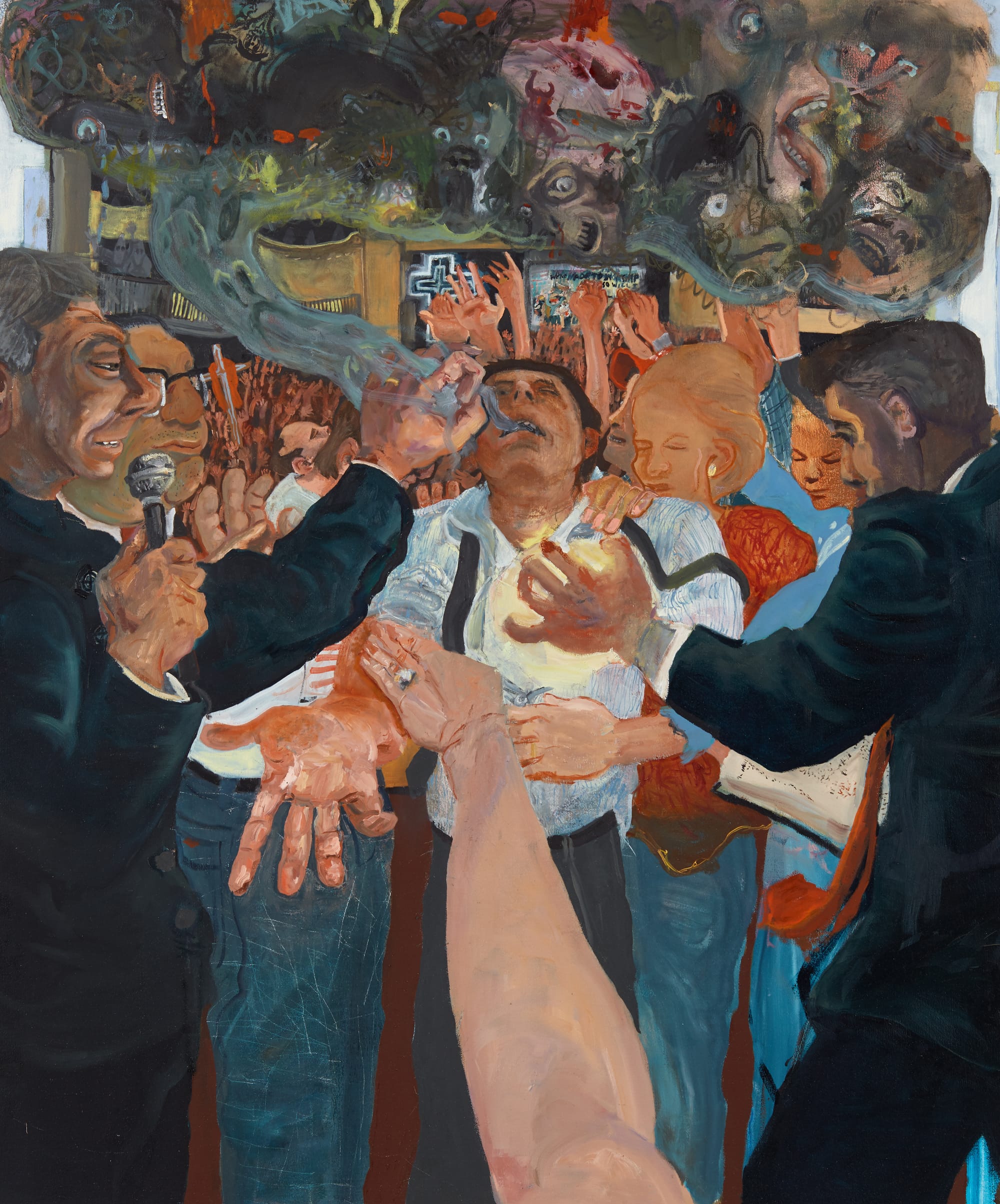 Celeste Dupuy-Spencer, “Through the Laying of the Hands (Positively Demonic Dynamism)” (2018) (photo Lee Thompson/Flying Studio, courtesy the artist and Adam Green Art Advisory)
Her upcoming solo show at Deitch, Burning in the Eyes of the Maker, grappled with the tension between the transactional nature of the art world and the political meanings she imbued in her works. In an artist statement for the exhibition, Dupuy-Spencer wrote that she approached her new paintings as a “conversation rather than a construction” and that the process of making work helped her reach inaccessible emotions and ideas.
“Painting, for me, is participation in the aliveness of life,” she wrote. “It is communication as recognition, not explanation. Meaning emerges only through encounter — when a viewer and a painting agree to stand in the same place and face the same uncertainty. The task is contact.”
Nina MacLaughlin, who co-authored a book with Dupuy-Spencer about her paintings that will be out with Phaidon’s Monacelli Press this summer, called her loss “a massive sadness” and said working with her was “one of the great honors of my life.”
“Celeste saw beyond. She saw through and she saw beyond and she saw what was right here and she showed us. She showed what most of us try to ignore, deny, scroll past. She looked for us. There was deep tenderness in her rage,” MacLaughlin told Hyperallergic. “No one had a mind like hers. No one. No one. She burned at a different temperature.”
🔗 Source: Original Source
📅 Published on: 2026-04-13 23:31:00
🖋️ Author: Aaron Short – An expert in architectural innovation and design trends.
For more inspiring articles and insights, explore our Art Article Archive.
Note: This article was reviewed and edited by the archot editorial team to ensure accuracy and quality.