
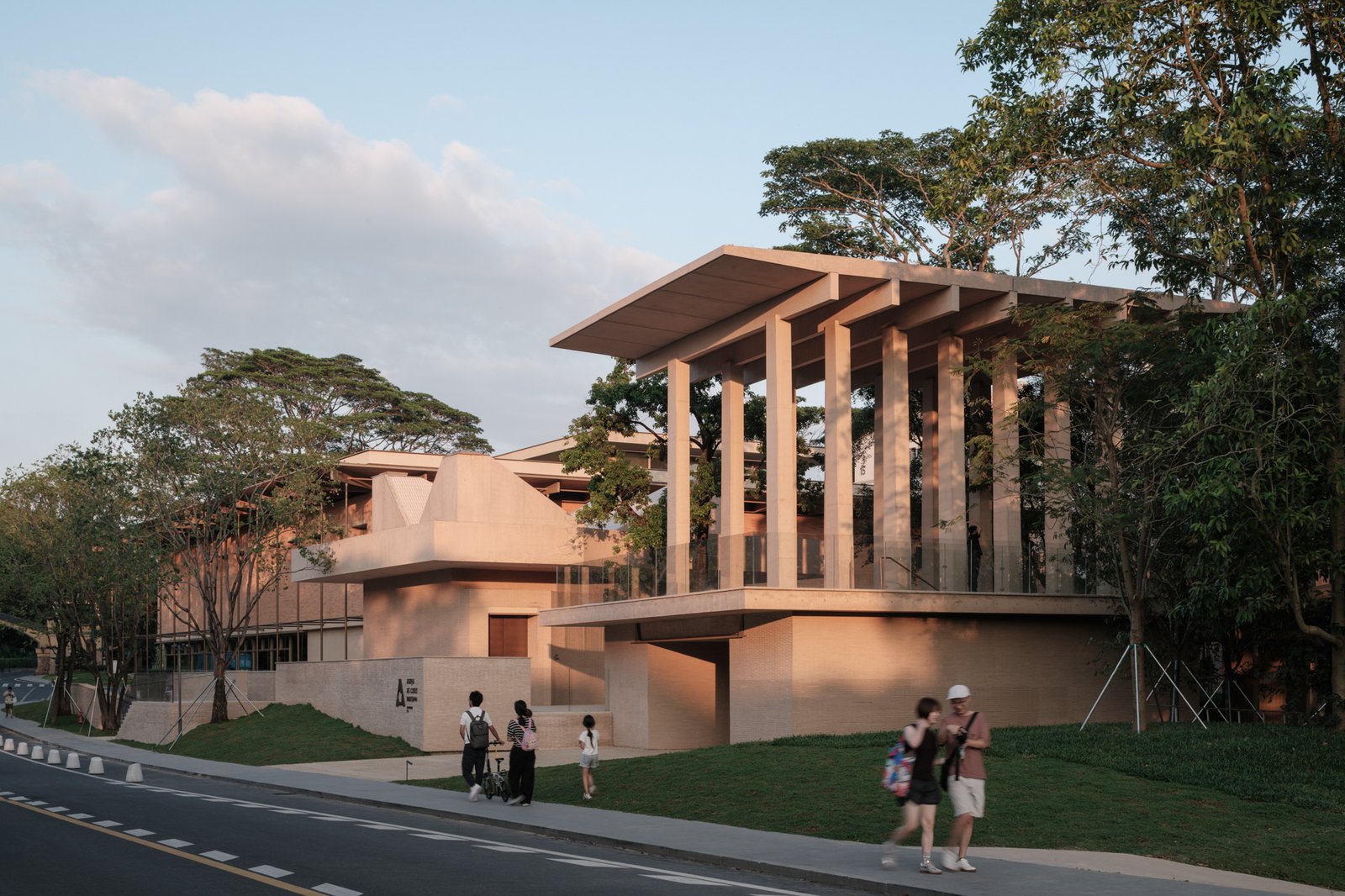
At Aranya Art Center Guangzhou and the Community Canteen, Vector Architects begins with what is already growing on the site. Existing trees and small changes in ground level shape the architectural approach, making preservation part of the design brief rather than a finishing gesture.
Working around what is there
The architects describe the project as the third in a sequence concerned with retaining trees and local topography. Their account connects it to a primary school in Shenzhen and a courtyard project in Jingdezhen. Across that work, corridors, walls and courtyards negotiate the space around existing planting.
For ArcHot, the interesting proposition is the reversal of the usual hierarchy: landscape can set conditions for a building instead of simply occupying the space left over. A tree has a position, a scale and a history that a new plan must answer to. Small variations in terrain similarly resist the convenience of treating a site as a blank, level surface.
Culture alongside daily life
The pairing of an art center with a community canteen also brings two different rhythms into the same project: the occasional visit to an exhibition and the repeated routine of a meal. That combination offers a useful question for cultural architecture: how can the setting for art participate in ordinary life?
Preserving trees does not, by itself, establish a building’s environmental performance. The more specific value here lies in an architectural approach that gives existing features a role in organizing new space.
Project: Aranya Art Center Guangzhou & the Community Canteen, Guangzhou. Architects: Vector Architects; lead architect Dong Gong. Source: ArchDaily, with project information supplied by the architects. Featured photograph: © Hao Chen.