Angelenos—and some out-of-towners—share early takes of LACMA’s David Geffen Galleries
The March/April issue of The Architect’s Newspaper features an article by Nate Hume that offers a detailed look at the structural engineering of LACMA’s David Geffen Galleries, designed by Peter Zumthor and SOM. To accompany Hume’s story, this latest print issue also includes opinions from architects, critics, and educators about the latest landmark building in Los Angeles.
Read on to see what Angelenos have to say about the building ahead of its upcoming opening on April 19.
Frances Anderton, writer, editor, curator, broadcaster, convener
“Peter Zumthor, the Swiss master of highly con-trolled and crafted, deeply sensual spaces, always seemed like an odd fit for Los Angeles, where its most effective and innovative designers have created an aesthetic out of the improvisational, expedient building culture here. Zumthor’s scheme inevitably had several of its sublime touches lost to costs or pushback, leaving us with a vast, elevated, glass-enclosed concrete concourse that certainly offers delights—like cinematic views outwards into the park and cityscape, and art blessedly free of the white box—but still has me wonder-ing if this is a grand folly, in both senses of that word.”
Andrew Atwood, First Office/UC Berkeley
“I like it. Of course I like how it looks, which should not surprise anyone who knows me, but more importantly, I like how I have experienced it, mostly during construction and from my car. Driving west on Wilshire, the street rises and the building sits at eye level. Then the street drops, and you realize you are about to drive under it. That sequence is distinctly Los Angeles in the most straightforward and unromantic way. Many people have famously written about Los Angeles architecture and cars, but I have always found much of that to be too abstract, too contrived. Here it is just literal. You drive at it. You drive under it. You drive through it. Most people will see the building from the street and from their cars, not from inside the museum or the LACMA campus. Even for that reason alone, I will always like it.”
Patrick Bernatz, Bernatz Studio
“I’m torn. It celebrates the kind of architectural risk-taking that defines Los Angeles, yet at close range, it struggles to connect at a human scale. The gallery spaces feel constrained, prioritizing views beneatht he canopy while sacrificing color at nearly every turn. Zumthor’s work is typically a true embodiment of craft, but this reads instead as an overly inflated tech monument.
Michael Bohn, Studio One Eleven
“Los Angeles is notorious for commissioning world-renowned architects with less-than-ideal outcomes. This appears to be the case for LACMA’s David Geffen Galleries designed by Peter Zumthor, and I would argue the same for the adjacent Broad Contemporary Art Museum by Renzo Piano. I admired Peter Zumthor’s precise and tactile work when visiting his Therme Vals spa in Switzerland and the Kolumba Museum in Cologne. Possibly the pressures of value engineering, patron demands, political caution, and lack of attention to detailing makes design excellence difficult to achieve here. Perhaps decision-makers are more interested in the designer label rather than the value of the product”

Michael Breland, Breland–Harper
“Cultural buildings shape the identity of a city. They are more than containers for art—they are civic stages where communities gather, exchange ideas, and see themselves reflected. I’m optimistic that the new LACMA building will not only house extraordinary work but also foster dynamic programming that strengthens Los Angeles’s cultural fabric for decades to come.”
Dana Cuff, cityLAB UCLA
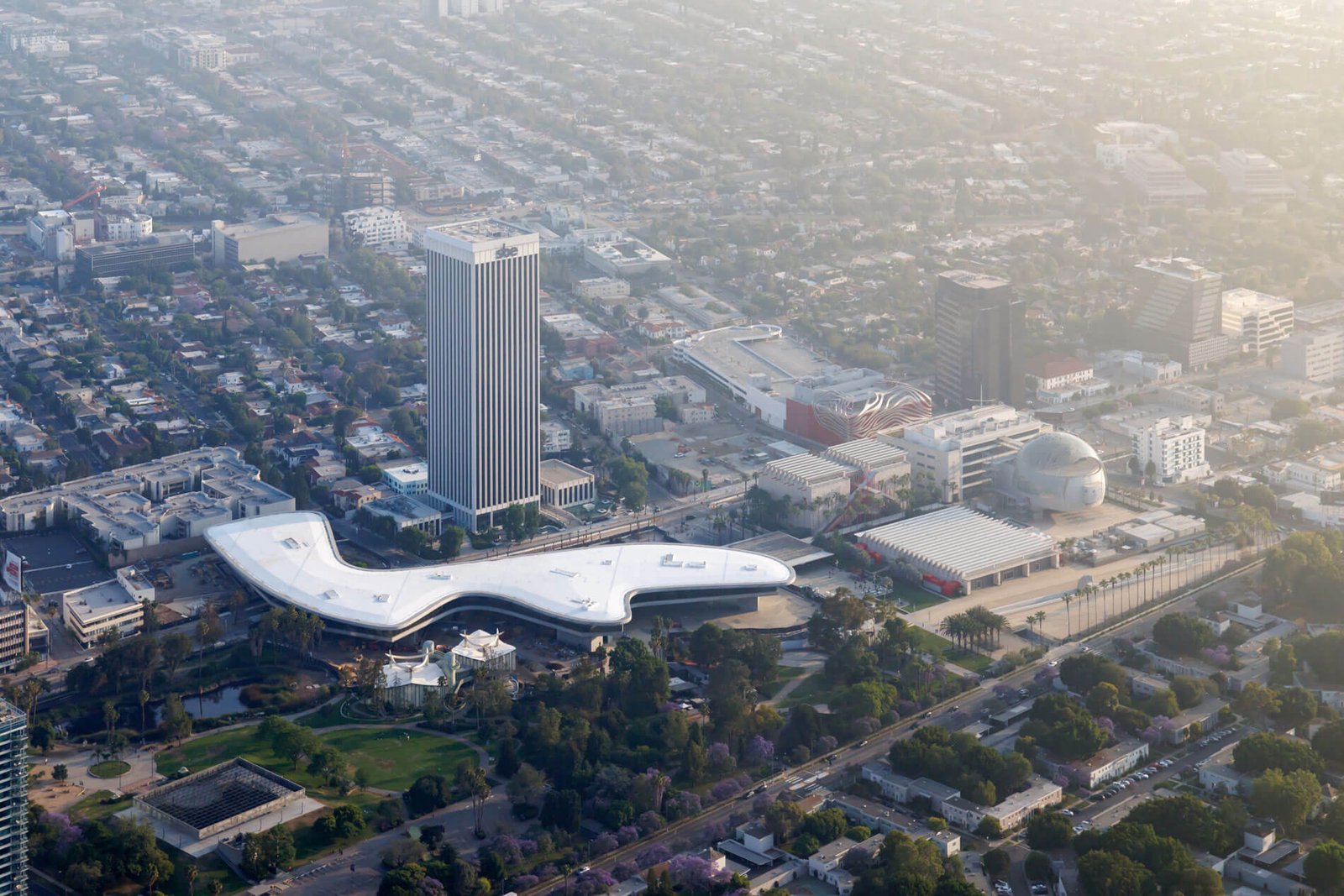
“LACMA’s new Geffen Galleries are the most recent reminder of Los Angeles’s sprawling landscape, growing out rather than up. Lazily crossing over Wilshire Boulevard, patrons meander on a single level through galleries scattered in an open field, looking out at th ecars below and the hills beyond. But that architectural sprawl also plays a pivotal urban role, putting a midpoint on the spine of L.A.’s greatest boulevard. Near one end of Wilshire, the Getty tops westside hills, and 17 miles east, Disney Concert Hall lays claim to downtown. With the Geffen crossing, L.A. is captured in a hub that’s got culture, street, plaza, and a place to hang out. Now that’s an architectural urban feat.”
Meara Daly, Daly PR
“Historically LACMA has not done a great job with its public spaces. The new building, while it forms a ‘plaza,’ would benefit from pulling the lushness (and nostalgia) of the tar pits through and into the outdoor spaces. Between the Zumthor building and Levitated Mass, it all feels very stark and sun-blasted to me. I am sure I am not the only one who wishes the OMA proposal from 2001 had been realized—it was a brilliant proposal, just at the wrong moment in time.”
Joe Day, Deegan-Day Design/SCI-Arc
“Opening between two museums overtly about film—the Academy of Motion Pictures Museum (2021) and the Lucas Museum of Narrative Art (2026)—Zumthor’s LACMA expansion is ironically the most cinematic of the three. And it should have been even more so. …
Had LACMA built OMA’s more audacious, ‘x,y,z’ scheme, L.A. could have hosted an encyclopedic museum as reimagined by Godard. Instead, looking out from its hovering plenum, we see Midtown, especially the rest of Museum Mile, as if reshot by Antonioni. I suspect most won’t mind that trade. Another prediction: It’s best now, empty.”
Ed Dimendberg, UC Irvine
“Trying to get a fix on how the LACMA campus will turn out is about as easy as obtaining a clear view of a spinning disco ball and much less fun. Better-informed friends and colleagues offer conflicting assessments. I have ceased making predictions about what surely will be the most consequential cultural project in LosAngeles since the Getty Center and Disney Hall. Is it the Bilbao Effect coming home to roost? Destination architecture is no longer the novelty it was when Frank Gehry built his Guggenheim in Spain, and today many value regionalism as a counterweight to homogenizing globalization. If Peter Zumthor’s museum on which both time and resources were lavished is anything less than stellar, the conclusion that the architectural profession has lost its way and is in desperate need of a reboot will be unavoidable.”
Julie Eizenberg, Koning Eizenberg Architecture
“I am a fan. I took a preview tour of the galleries on a hot September day last year, and the interior was cool, soulful, and seductive—a welcome departure from big white rooms. The unconventionality will likely push curatorial invention. I am curious to see how art, artifacts, and architecture play together.”

David Eskenazi, d.esk/SCI-Arc
“I don’t really get all the hate. Most people will love it. The building cuts a curve against the sky, views Los Angeles through a continuous wide-screen vista, and makes Wilshire feel more like part of the park. The whole thing seems light and familiar. Plus, you get to drive under it. The confetti plan is the riskiest bet of the project. It makes sense as a reading of L.A., but it requires a deft hand and finesse. I’ll be curious to see how it works out.”
Jia Yi Gu, Spinagu/Harvey Mudd College
“The thing I like the most about architecture is that it doesn’t always have to be a building. It can also be a utility, a procedure, a social technology, or a proposition. The architectural element I like the most about the David Geffen Galleries at LACMA, therefore, isn’t necessarily the building itself; it is the proposition of all the other buildings that it could have been instead.”
Eva Hagberg, author, educator, historian, media strategist
“Everyone’s been talking about the new LACMA building. The general take has been a critique/lament of an imaginary yet missed opportunity mixed with general dissatisfaction. And then there’s the occasional person who’s actually been inside, claiming that, from the interior, it works, it really works!
All I can say is on a recent family visit to LACMA, we spent a few minutes really looking at the northern half of the building. We marveled at the clarity of the sharp edges, the perfect proportion of the windows, the details on the concrete. ‘Zumthor never misses,’ one of us said. I haven’t been inside yet, but from that brief encounter, it’s possible that, despite the chatter, he hasn’t.”
David Heymann, David Heymann, Architect/University of Texas at Austin
“Much of the preopening speculation has focused on how the splatter form and unforgiving concrete of Zumthor’s upper gallery will perform. But one powerful architectural effect is already evident at the ground plane. The voids between the massive ground floor blocks generate terrific desire lines between the public spaces of LACMA’s entry plaza to the west and Hancock Park to the northeast, reintroducing continuity across the larger site. But you won’t be able to follow through on those architectural invitations, as the new wing’s extensive grounds are being fenced in for outdoor sculptures.
The distinct geometry of that security fence—a continuous palisade of green spikes—is surprisingly present. It has one particularly unfortunate effect: From outside, it now feels a bit like you’re looking into a zoo enclosure. That sense—art snob habitat!—is sharpened by the landscape architecture’s concrete ‘sand and oil’ paving design. Conceived by the late Robert Irwin, probably to rankle yet another too-serious architect, it seems woefully underdeveloped.
Zumthor is notoriously mortified by compro-mise. The public space that fence and landscaping generate must be truly galling.”
Andrew Holder, Los Angeles Design Group/Pratt Institute
“There was a moment during construction of the museum when cement trucks were lined up on Wilshire, waiting to sluice concrete into a hole that was, against all intuition, right there in the middle of the boulevard. Whatever else it may be, the addition is an act of civic infrastructure, which I would far rather see emerge from arts institutions like LACMA than the city’s own planning machinery. It’s almost utopian. Let’s do it again.”
Katie Horak, Architectural Resources Group
“In the new Geffen Galleries, moments of beauty arrive unexpectedly: Bruce Goff’s Japanese Pavilion in perfect frame; cars passing beneath your feet along Wilshire Boulevard; the building turning back upon itself, muscular and sinewy. But are these moments enough? Will the art and objects of the collection shine inside a building that seems more invested in its own statement than in its purpose? Time will tell.”
Sean Joyner, writer
“I proposed to my wife at LACMA, under the Urban Light sculpture. I met Flea there. I grew up wandering the campus before I had language for what architecture was or could be. My sons, four and six, will inherit its new building in the same way, through embodied experience, before buildings become legible to them as architecture. They’ll know the weight of the concrete floating off the ground the way I knew the Pereira courtyard, as fact before feeling, feeling before opinion. Angelenos will claim this building over time, on their own terms. The building has to earn that kind of intimacy. Zumthor’s design has yet to prove it can.”
Alan Koch, Lovers Unite
“The new LACMA building is a welcome alternative to the stranglehold of sealed light-box museum spaces .I love this grand scale revisit of Los Angeles’s noirish DNA under deep, shadowy overhangs, especially at the county’s namesake museum. Zumthor’s doubling down on vibey concrete spaces presents a fresh, modern noir context, opening up to a wraparound Los Angeles panorama. The collection is going to feel interestingly cinematic in this bold context.”
Mark Lamster, Dallas Morning News
“I have a good many questions about the new LACMA, but my fundamental concern is with the display of art in galleries with unbroken window walls that seem destined to create serious glare and silhouetting problems. It seems to me that all other issues take a backseat to this one, as it is the entire raison d’être of the project.”
Michael Maltzan, Michael Maltzan Architecture
“Big, curvy, floating—for all the seeming detachments to the surrounding scene, Peter Zumthor’s new building at LACMA does everything to sidestep those preconceptions and criticisms. It can be slippery, it can be heavy-handed, sometimes both simultaneously, but it pushes and pulls the city around it into an undeniable conversation. … Putting aside exterior form for a moment, it’s ‘up there’ on the lifted plane of galleries where the design’s real newness resides. Here one meanders and weaves between city and art, simultaneously challenging and celebrating both. Can one be a flaneur inside a building?”
Thom Mayne, Morphosis
“LACMA is not a building. It’s a crossing infrastructural logic: horizontal, indeterminate, open to demands not yet formulated. That openness is Los Angeles. The building thinks horizontally—it bridges Wilshire; you encounter it in motion the way the city reads everything: at speed, in intersection, through glass. The encounter is cinematic before it’s spatial. The boulevard doesn’t stop at the building; the building belongs to the street. It activates rather than anchors, connects rather than terminates. The project constructs a capacity for iteration and transformation. The future of Los Angeles is not contained in what the building is but in what it can become.”

Shane Reiner-Roth, writer, photographer, educator
“In May 2020, shortly after demolition began and public scorn over the use of public funds continued unabated, I wrote in AN that a little patience may likely yield ‘an outsized reward.’ Visitors, no longer encumbered by the original LACMA campus impediments, could one day treat the museum and grounds as their own as they glide across Hancock Park through and beneath Zumthor’s tabletop.
Six years later, a row of green metal poles along Wilshire Boulevard almost imperceptibly deny access to the site outside of museum hours. They fall short of obstructing the words DAVID GEFFEN GALLERIES, which are suspended from the belly of the tabletop and cast a long shadow over its concrete base in the late afternoon.”
Michael Ross, writer
“Peter Zumthor is a brilliant architect. I’ve met him in Switzerland, visited his home and office, and experienced his poetic skill and refined detail-ing at several buildings. Zumthor called the baths at Vals ‘stone and water: a love affair.’ Yes, it was.
I visited LACMA before the art was installed. Having the galleries all on one level is a good idea. The bridge over Wilshire Boulevard is a strong urban design gesture, but the overall experience was underwhelming. The concrete seemed cold and rough. Somehow Zumthor’s artistic touch was missing. Maybe after the art is installed it will be a calm, neutral backdrop for the museum’s true purpose.”
Mohamed Sharif, Sharif, Lynch: Architecture/UCLA
“Of the four recent horizontally oriented projects hovering at various heights above L.A. and giving it new centers of gravity, Zumthor’s haute-grunge room-in-the-ribbony-round is the most simultaneously immersive and expansive of the lot.
More intimately scaled than MAD Architects’ bobbing blob-cum-triumphal arch, Michael Maltzan Architect’s hopping-skipping-and-jump-ing viaduct, or HKS Architects’ ground-sweeping and downwardly corkscrewing stadium, Zumthor’s inhabited bridge is the people’s promenade of perceptual pleasures.
A sinuous viewfinder, it stitches the museum campus’s loose bits and pieces into dioramic and panoramic consilience and coherence. Whether looking at it, from it, or through it, near and distant skylines bounce back and forth at varying speeds, folding moments of painterly stillness into stretches of filmic vigor.”
Dori Tunstall, design anthropologist
“The undulating structure of the David Geffen Galleries means you cannot fit the entire building into one view. Coming from the La Brea Tar Pits, the building’s tail appears as a mundane pedestrian overpass over Wilshire, nestled within low-rise office buildings and the Tar Pits’ prehistoric exotica. But approaching from LACMA, the building seems like an offspring of Louis Kahn, with sculptures, a cafe, and a library clarifying its cultural purpose. Mark my words: When viewed from the plaza, the building will soon be publicly called ‘the Jet-sons’ house of modern art.’”
Clive Wilkinson, Clive Wilkinson Architects
“Why are people inclined to hate Zumthor’s supposedly crude LACMA building? It is an oddity of the assembled cocktail party that is LACMA. It stands out and appears awkward, but it takes one moving through the grounds and the structure to realize how brilliant anew companion it is. Suddenly the landscape is opened up. Renzo Piano’s buildings can be appreciated, Goff’s Japanese pavilion is finally foregrounded, and the Hollywood Hills become a splendid panorama. Below the decks, the rich traffic flow of Wilshire Boulevard only serves to validate the interventions of art, which is surely LACMA’s reason to exist.”
Mimi Zeiger, critic, editor, curator, instigator
“Last summer, when LACMA opened the doors of the David Geffen Galleries for a tantalizing sneak peek, reactions swiftly cut across party lines: Those who dig the allure of brutal Swissness seemed pleased; others pointed out lime stains and less-than-meticulous concrete detailing. The new building is appealing in the way a dam or highway is appealing. (It’s impossible to knowhow it’ll look with artwork banged into those massive walls.) With this bridge to nowhere, Zumthor (and SOM) may have produced infrastructural thrall, but is it a museum—a county museum meant to serve all Angelenos? With a vast, sun-blasted plaza and vertiginous climb to the first floor, it’s a dubious welcome”