
✕
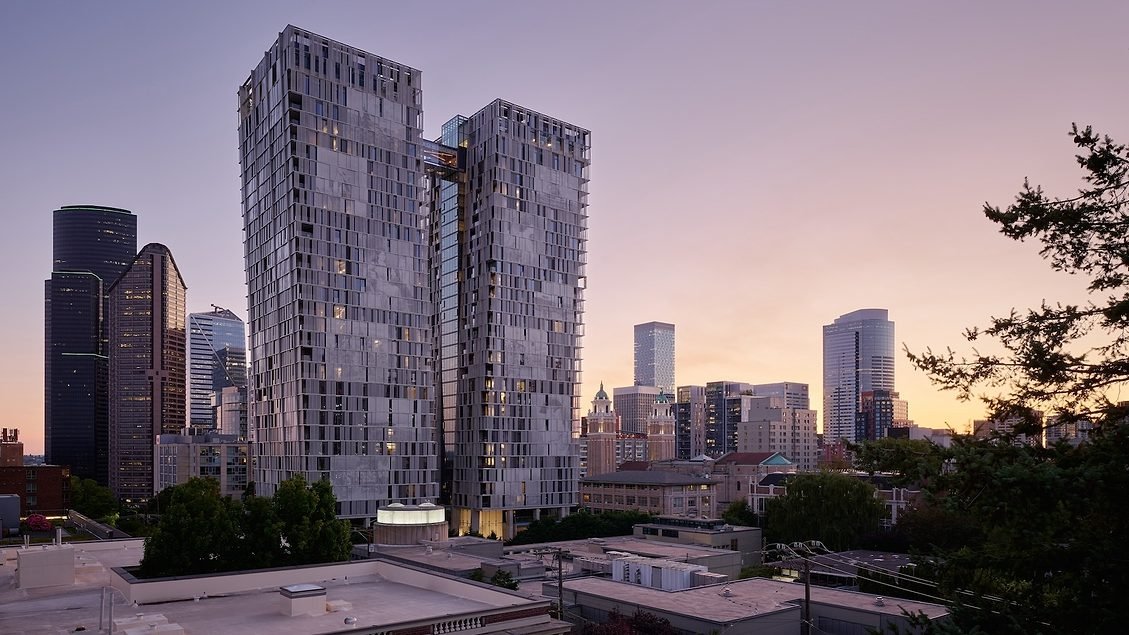
For years, a paved surface parking lot sat directly west of Seattle’s Frye Art Museum, offering visitors a free place to stash their cars while they browsed the exhibitions. Stop by the Frye today, and you’ll find a very different neighbor in Museum House, a 33-story, residential development comprising two angled towers connected by a glassed-in bridge. Developed by Vancouver, B.C.’s Westbank—a real estate company known for integrating art into many of its projects—and designed by the Seattle office of Perkins&Will, Museum House is a turning point for the First Hill neighborhood, which sits adjacent to downtown on the opposite side of Interstate 5 and is best known for being home to multiple major hospitals and health-care facilities.

Photo © Kevin Scott
“A lot of the initial planning was all about making the project feel tied metaphorically to the Frye, as well as physically, in terms, of the components and material choices,” says Perkins&Will principal and design director Ryan Bussard, who notes the shared use of concrete, the presence of round apertures, and minimal composition—just at different scales. “Even the way our entryway lines up with theirs is a nod to the museum.”
Inspired by the concept of Gesamtkunstwerk, a German term meaning ‘a total work of art,’ the design team looked to the Frye Art Museum as an aesthetic springboard. A beloved institution—originally designed by Pacific Northwest modernist Paul Thiry, with a major 1997 renovation by Olson Sundberg Architects (now Olson Kundig)—the museum is known for its free admission, dedication to contemporary and local artists, and its salon-style gallery, hung with floor-to-ceiling works from the founders’ original collection of paintings by American and European artists.


Photos © Kevin Scott

Photo © Kevin Scott
It was this gallery that kicked off the idea for Museum House’s facade, which blends art and architecture in a series of sliding aluminum screens printed with popular works from the museum’s permanent collection. Controlled by residents, the screens—which provide thermal and light regulation, and privacy—create an ever-changing pattern throughout the day. At night, the building glows from inside like a lantern on the hill.
“The density of the image is [determined] by the hole-shaped perforations,” says Perkins&Will associate principal Gavin Smith of the screens. “We did a lot of studying, including draping prints from the balcony in a parking garage downtown. Our team members got in trouble for doing that!”

Photo © Kevin Scott
While the building’s facade is visually striking, its form also stands out. The two towers, which contain 506 residences (from studio apartments to three-bedroom units), appear to be leaning slightly away from each other, in a north-south direction. A glass spine shoots up the inner sides of each tower, connected at the top by the bridge, which also serves as a lounge space for residents. Crowning each tower is an outdoor terrace: the south deck holds a rare-in-Seattle swimming pool, and the north, a greenery-filled gathering space. An additional amenity zone on level three includes a dog run, outdoor seating area, and flex-use rooms popular with those who work from home.

Photo © Kevin Scott


Photos © Kevin Scott
“We were thinking in terms of creative tension,” says Bussard of the design. The outward lean is due to incremental stepping at each floor, which creates tiered balconies that either increase or decrease in depth, depending on the side of the building. Structural concrete piers are visible at the towers’ north and south ends, but recessed at the east and west elevations to give full range to the art-printed screens.

Photo © Kevin Scott
The skybridge, which has a series of glazed openings that look straight down, is more than just a way to cross from tower to tower. During seismic analysis, engineers found that the movement between the two towers could shift up to eight feet in an earthquake. The solution was adding a steel X-brace over the bridge. “This is literally tying together the two building cores,” Bussard says. The brace reduced potential seismic movement to just six inches. With its glass walls, the bridge offers sweeping views in two directions: over the city and out to Puget Sound looking westward, and towards Lake Washington and the Cascade Range to the east. “We were trying to keep it as light and transparent as possible,” Smith says.

Photo © Kevin Scott

Photo © Kevin Scott
At the bases of each tower are commercially zoned spaces that the architects hope will eventually be populated by restaurants, galleries, or boutiques, further stitching the project in the fabric of the city. “Ian [Gillespie, the founder of Westbank] has always been curious about how a project fits into a larger narrative,” Bussard says. “He was fascinated by the Frye Art Museum, but he also saw First Hill as the glue that ties other neighborhoods together.” Museum House now sits as a creative beacon, combining art and architecture, past and present, into a project squarely rooted on a block with the potential to become Seattle’s next creative district.
-2_pages-to-jpg-0001.jpg "Museum House Seattle")
_pages-to-jpg-0001.jpg "Museum House Seattle")
-3_page-0001.jpg "Museum House Seattle")
Images courtesy Perkins&Will