DIGSAU and MJMA Design a Muscular Addition to Princeton’s Dillon Gymnasium
✕
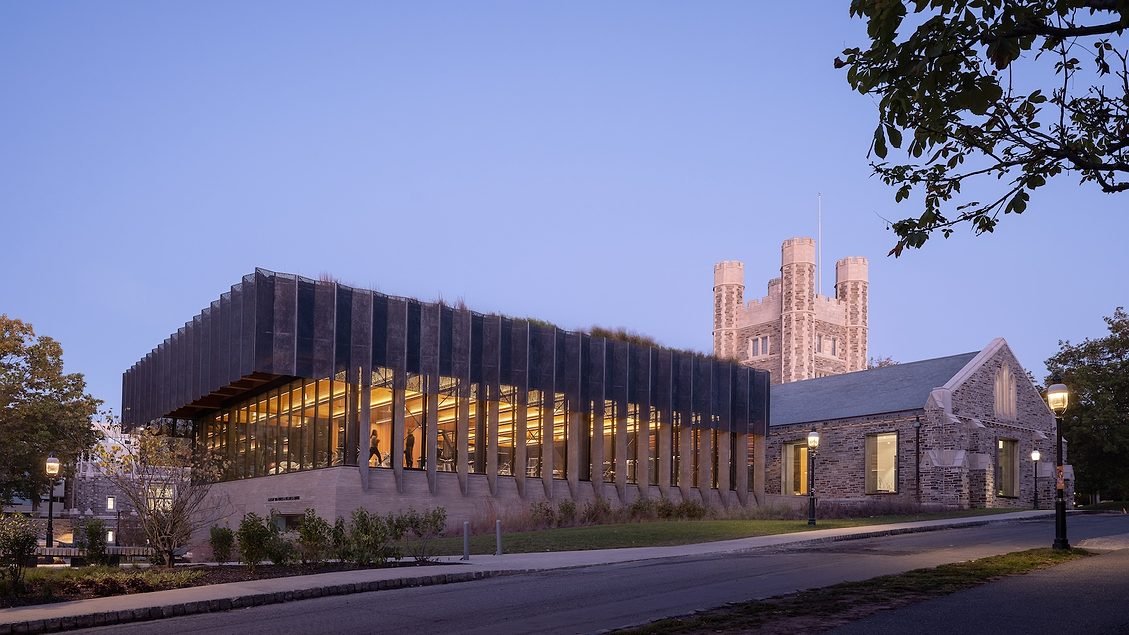
Princeton University is growing at an unprecedented pace. Not only is the undergraduate class of 2026 one of the largest in the New Jersey school’s nearly 300-year history, there’s also a building boom. According to Princeton’s facilities department, 15 new buildings—including the Meadows Apartments by Mithun, the Princeton University Art Museum by Adjaye Associates with Cooper Robertson, and the Frist Health Center by WRNS Studio—have opened since 2022, with a few more under construction and slated for completion in the coming years. As Ron McCoy, the university architect, points out, “This generation of projects totals 3.2 million square feet.” One of the most recent additions to this tally is a 45,000-square-foot fitness and wellness center by DIGSAU and MJMA, who renovated and expanded the storied Dillon Gymnasium.

Aerial view of the Class of 1986 Fitness & Wellness Center/Dillon Gym. Photo © Scott Norsworthy
Built in 1947, Dillon replaced the former University Gymnasium, which stood on the site from 1903 until it was destroyed in a fire along with the irreplaceable memorabilia and sports trophies it housed. Replicating its Collegiate Gothic style and even incorporating some of the original’s fire-blacked walls, the new gym’s 98-foot-tall tower, composed of Princeton’s characteristic argillite fieldstones with prominent quoining, rises in the central area of campus at the top of a steep hill.
The RECORD review of the original gymnasium from 1904 critiqued it as “an attempt to clothe a modern proposition in ‘Monk Latin.’” But that mixing of a modern type and medieval decor is precisely what also makes Dillon architecturally interesting: Despite the stereotomy of its stone exterior, it is a lightweight fieldhouse structure. Steel trusses support a lofty basketball court on the upper floor (where, in 1972, the Grateful Dead famously performed). As the gym traverses the site’s slope, the lower level cantilevers over an Olympic-sized swimming pool at the building’s south end. To do so, the entire level is essentially turned into a plenum occupied by a dense series of full-height modified Warren trusses. These trusses were then clad in thick butcher-block-like wood paneling to be used as 19 squash courts.

The new tower entrance plaza. Photo © Scott Norsworthy
Despite the recent pickleball craze, squash has not found the same popularity, and the facilities have been chronically underused. Many of the courts were repurposed as storage. The rapid development at Princeton follows a strategic planning process started in 2014 that sought, among its many goals, to revitalize the university’s aging and underused facilities. The plan also aimed to establish better interconnectivity on campus. It identified an east-west path that could serve as a new primary corridor. The gym’s parking lot to the south—which had been filled with trailers serving as temporary offices—sat on this axis, and if the building were reoriented toward the east-west connector, Dillon could serve as a central node, bringing students to the site.

The new addition is a steel and mass timber hybrid structure. Photo © Scott Norsworthy

Photo © Scott Norsworthy
The school invited both Philadelphia’s DIGSAU and Toronto-based MJMA, among others, to respond to an RFP process. The two architecture studios requested permission to codesign the renovation of and addition to Dillon. “We were probably both invited for slightly different reasons,” explains Mark Sanderson, principal in charge at DIGSAU, noting that his firm “focuses more on materiality and place-making,” while MJMA “is internationally renowned for its recreational facilities.”
The team’s design centered on a renovation and repurposing of the squash courts and the addition of a weight room, multipurpose studios, and a lounge onto the southeast end of the building. The remainder of the gym parking lot was converted to an outdoor basketball court and gardens by landscape architecture firm Field Operations. The plaza in front of Dillon’s tower was also redesigned to become the primary entrance.

New basketball court at the former site of a parking lot. Photo © Scott Norsworthy

Common area with shuffleboard table. Photo © Scott Norsworthy
The heavy wood paneling was removed from the steel trusses, which were then restored, painted white, and left exposed for a muscular industrial finish in the new workout areas. Local high school students enrolled in the Challenge Program—a nonprofit that provides practical training for at-risk youth—stripped the paneling of its paint, dislodged many of the screws and nails embedded in it, and turned the lumber into furniture pieces for the new gym, including stools, ottomans, a shuffleboard table, and most prominently, a reception desk at the building’s new main entrance. The salvaged material bears the dents and scars from decades of being hit by volleyed rubber balls
.

Exposed mass timber in the addition. Photo © Halkin/Mason Photography

The new workout areas feature stripped-down, industrial finishes. Photo © Scott Norsworthy
The addition pays homage to the original without replicating its Collegiate Gothic style. A square base, reaching up to 19 feet tall on the court side, is composed of bricks chosen for their color to approximate the varied hues of the argillite fieldstones. On top of this base sits a glass and steel box that supports an oversized glulam roof, making it the sixth timber structure on Princeton’s campus. “A hybrid structure makes sense,” says Ted Watson, partner in charge at MJMA, “because steel does certain things well and mass timber does other things well.” The addition’s roof is ringed by a corrugated brise-soleil of darkened bronze panels, which hang down to shade the window walls. These scrim-like panels are perforated in a complex water-jet-cut dot pattern that was derived from overlapping the shapes and profiles of the Gothic windows, stonework, and string courses.

1

2
New main lobby, including furnishings made from salvaged lumber (1); exposed steel trusses in a workout area (2). Photos © Scott Norsworthy
As Princeton’s student body grows, a goal with all its new facilities is to provide welcoming spaces for everyone. But as Sanderson points out, “Your version of being welcomed might be different than the next person’s.” Beyond accommodating weight rooms and exercise areas, the architects provided ample unprogrammed spaces ranging from public lounges, furnished with sofas and the salvaged-wood pieces, to intimate nooks under stairs or cushioned window ledges. “If you show up to the space and you don’t do any athletics,” Watson adds, “but just hang out with friends, then that’s a big win.”