Annabelle Selldorf Joins RECORD for an In-Depth Look at the Transformed Frick Collection
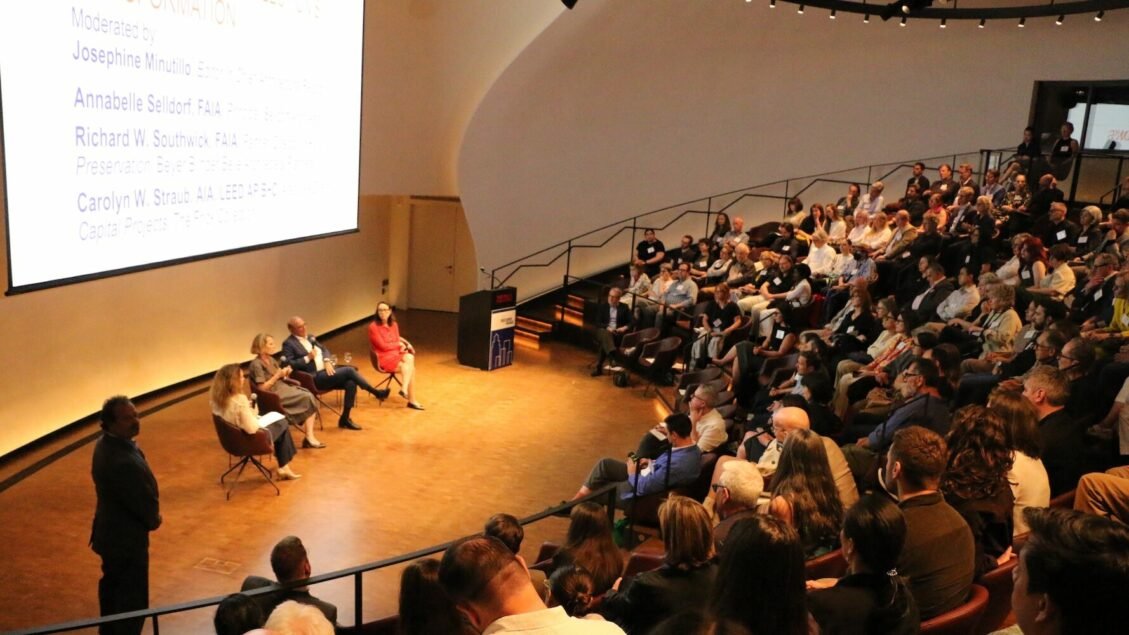
More than 200 attendees joined Architectural Record on the evening of June 27 for a special edition of the Record on the Road event series celebrating the reopening of the Frick Collection following a lauded renovation and expansion led by Selldorf Architects with Beyer Blinder Belle (BBB).
The event was held in the Manhattan art museum’s new subterranean auditorium and its anteroom, which are tucked deep beneath Russell Page’s 70th Street Garden. The much-loved viewing garden—restored as part of the multiyear makeover—would have been wholly erased in an earlier expansion proposal that predated Selldorf’s sophisticated, surgical approach to modernizing and enlarging the beloved Upper East Side institution. The museum, housed in the former Carrère and Hastings–designed manse of industrialist Henry Clay Frick, first opened to the public in 1935 following its conversion into a public art space by John Russell Pope.
Featured speakers at the event included Annabelle Selldorf, principal of Selldorf Architects; Richard Southwick, partner and director of historic preservation at BBB; and Carolyn Straub, associate director for capital projects at the Frick. Selldorf and Southwick both gave individual presentations detailing the dramatic, $330 million transformation while all three joined RECORD editor in chief Josephine Minutillo for a panel conversation. The museum’s new (as of this spring) director Axel Rüger, previously chief executive of London’s Royal Academy of Arts, also gave remarks. Representatives from EeStairs kicked off the evening with a CE session focused on the design, fabrication, and installation of the museum Reception Hall’s new five-story, marble-and-brass stair, which attendees descended to reach the auditorium.

RECORD editor in chief Josephine Minutillo leads a lively discussion with Selldorf, Southwick, and Straub. Photo © Architectural Record
During the final hour of the program, attendees were free to explore the galleries of the transformed Frick, including on the long roped-off second-floor of the mansion, which in its original iteration served as the private quarters of the Frick family and later housed administrative offices.
With its sinuous proscenium, the auditorium, which will host concerts, lectures, and other events, is indicative of the Frick’s mission to expand its educational initiatives and public programming. “It was very important to provide spaces where people could be taught, where they could be introduced to the building, and where they could feel welcome,” said Selldorf. “A very big aspect of the project was making the visitor experience better.” (In addition to the auditorium and a main-floor education center, new public facilities include a new gift shop and café, along with vastly improved accessibility features, enhanced circulation and connectivity across the museum complex, and updated infrastructure and mechanical systems for better guest and employee comfort.)
“When we renovated the building, we wanted to return it to the public just as beautiful—or even more so—than before,” adds Selldorf, noting that the auditorium “while perhaps more expressive and modern” than other areas of the museum, “entirely keeps with the big idea of being welcoming and people-centric.”

1

2
Selldorf shows the museum’s grand stairs, now accessible to the general public (1); Southwick details BBB’s complex preservation plan for the landmarked site (2). Photos © Architectural Record
Following Selldorf’s presentation, Southwick provided event attendees with a fascinating deep dive into the history of the site—once home to the Lenox farm, then the Lenox Library, designed by Richard Morris Hunt—including myriad past alterations and revamps to the Frick. He described the preservation tools used to approach the project and also discussed the guiding preservation plan, focused on the objectives of research, assessment, analysis, and guidance. “The quality of Frick’s original mansion and the museum was always the absolutely highest, both in design and in construction. And it was paramount that this design team and the construction team met that same level of quality all the way through,” said Southwick. (Sciame, a partner on the event, served as construction manager.)
In the group conservation that followed, Southwick aptly described the difference between the reopening of the Frick and the recent debut of the renovated Rockefeller Wing at the Metropolitan Museum of Art, a project led by WHY Architecture with BBB. “They’re very different— the Rockefeller, which has an incredibly wonderful collection, is almost like you’re welcoming a new friend,” he said. “The Frick, being out of the eye of the cultural environment in New York for a number of years, is like welcoming an old friend back. I think it was sorely missed and that’s why the reception’s been so strong over the last few months.”

Frick Collection director Alex Rüger greets attendees. Photo © Architectural Record
The reception, as mentioned by Southwick, has been robust. The Frick is currently in a post-reopening honeymoon period greeting 3,000 visitors per day. But when asked if another transformative capital project might be further down the road, Rüger explains that this museum, with 3,000 daily visitors, doesn’t “give you the quiet, contemplative oasis that the Frick was always so known and appreciated for. But the truth is also we cannot afford only to have a hundred visitors a day—it’s a careful balance that you must strike between the experience and your economic needs.”
And even if the Frick does seek to expand its footprint in the future, Selldorf notes that “we don’t have room to put another addition—basically, this is it for at least the next 100 years.”
Join us for the next edition of Record on the Road, a special edition of the Sustainability in Practice conference held at the Illinois Institute of Technology’s landmark Crown Hall, on September 10. Registration is now open here.