In Seattle, Graham Baba Architects Transforms a Gritty Industrial-Marine Site into a New Waterfront Destination
Even for longtime residents, the area of Seattle where the northern slope of Queen Anne Hill meets the Lake Washington Ship Canal is difficult to pin down and assign to a distinct neighborhood. Separated from Ballard’s similarly hardworking waterfront by Salmon Bay and just a touch too far east to lump in with Interbay and its bustling Fishermen’s Terminal, this industrial-maritime area exists as an in-between place—an intersection, really—surrounded by neighborhoods that it can’t claim as its own.
West Canal Yards, a nine-acre redevelopment project at the former site of a long-running fish processing facility, inspires to activate this anonymous slice of prime bayfront real estate that has long been off limits to the public. Opened last spring, this fledgling micro-district with nearly 1,000 lineal feet of wharf frontage is spread across two cannery structures—a freezer building with a 30,000-square-foot cooler and a smaller neighboring warehouse with office space—smartly adapted to attract galleries, creative start-ups, tech companies, maker spaces, retailers, and maritime-oriented businesses.

Before shot of the former fish processing plant. Photo courtesy Graham Baba Architects

Post-renovation view. Photo © Ed Sozinho
“No one knows what it is—it’s kind of just the backside of Queen Anne,” says Jim Graham, co-founding partner of Seattle-based practice Graham Baba Architects (GBA). With a portfolio rich in adaptive reuse projects, the firm worked with developer Unico Properties to create a master plan for and transform two hulking buildings at a site just east of the Ballard Bridge that was previously part of what Graham calls a “no man’s zone” comprising large industrial parcels wedged between Nickerson Street and the ship canal, which links the Puget Sound with Lake Washington via the Ballard Locks.

Archival 1950s aerial view of the Lake Washington Ship Canal. The 8-mile waterway was historically home to a number of sawmills. Photo courtesy Graham Baba Architects
“Subcontractors we were trying to bring on would always ask ‘where is it?’ And they’d start guessing … and never get it,” Graham says. He notes that the project wasn’t just an opportunity to revitalize an abandoned and once-inaccessible waterfront property but rebrand it and give it its own distinct character—and name: West Canal Yards.
The scope of the project was limited by the area’s strict shoreline and marine-industrial zoning overlay that protects and promotes water-dependent industries while prohibiting residential development. While zoning changes will eventually impact the area, they could be decades out. The desire to open up and activate the site, however, was immediate despite the complex limitations on what the design team could and couldn’t do. Further complicating matters was the fact that the entire site is built on piles, limiting loads.


The combined freezer/processing building has a flexible layout of suites meant to appeal to creative start-ups, marine businesses, research and development firms, and more. Photos © Ed Sozinho
With more than 180,000 rentable square feet spread between the two old cannery buildings, West Canal Yards has a current tenant list that includes an architecture firm, a letterpress studio, the corporate offices of a seafood company, a coworking and event space, and a major Seattle art gallery that relocated from downtown. Shared amenities include a communal kitchen, conference room, fitness facilities, and showers and lockers. Outside is a beer garden, shared patio, and large gathering space along the ship canal. More businesses, including a brewery, are on their way.

The main entry to the old freezer building. Photo © Ed Sozinho

Interior of the smaller former warehouse/office, which was rehabilitated with a lighter touch compared to the neighboring freezer/processing building. Photo © Ed Sozinho
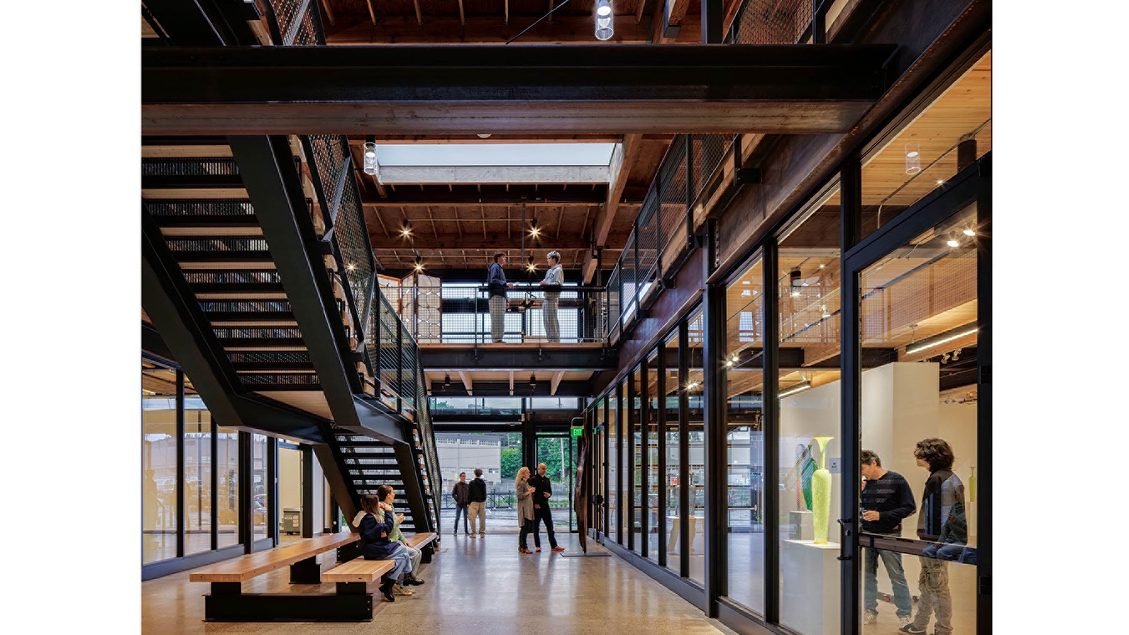
Much of GBA’s focus was on the transformation of the larger former freezer/processing building—technically two adjacent, firewall-separated structures—from a windowless concrete vault to an airy, flexible mixed-use complex spread across two floors. A “zipper” of skylights was cut through the roof; four-foot-wide tilt-up concrete panels were swapped out with windows, doors, and aluminum curtain wall; and steel and mass timber mezzanine floors were inserted to nearly double the building’s usable space. “We had to cut it apart,” says Graham.

1

2

3
Before (1), process (2), and after (3) views of the old freezer space. A main tenant of the building is the Traver Gallery. Photos © Ed Sozinho
Despite GBA’s expertise in breathing new life into old industrial structures, adapting the larger of the two buildings was a novel experience, particularly dealing with such an immense amount of tilt-up concrete that needed to be removed. “There were structural gymnastics involved,” says Graham. “And I’d never come across a 30,000-square-foot freezer before.”
Containing five large suites, the smaller warehouse/office building was fully renovated but did not undergo the same significant alternation as the freezer building where leasable square footage was added. “It was a low-budget redo to repopulate it with both office and manufacturing,” Graham explains.

View of the site at Salmon Bay with the Ballard Bridge in the distance. Photo © Ed Sozinho
One major element of West Canal Yards that is already designed but has yet to be installed is a giant rooftop sign with a classic steel armature that will be visible from all around: Nickerson Street, the South Canal Trail, Salmon Bay, and the neighboring Ballard Bridge. Reading simply “West Canal Yards,” the sign will signal to Seattleites that this once-unknown stretch of waterfront has officially arrived—and at long last has a name.